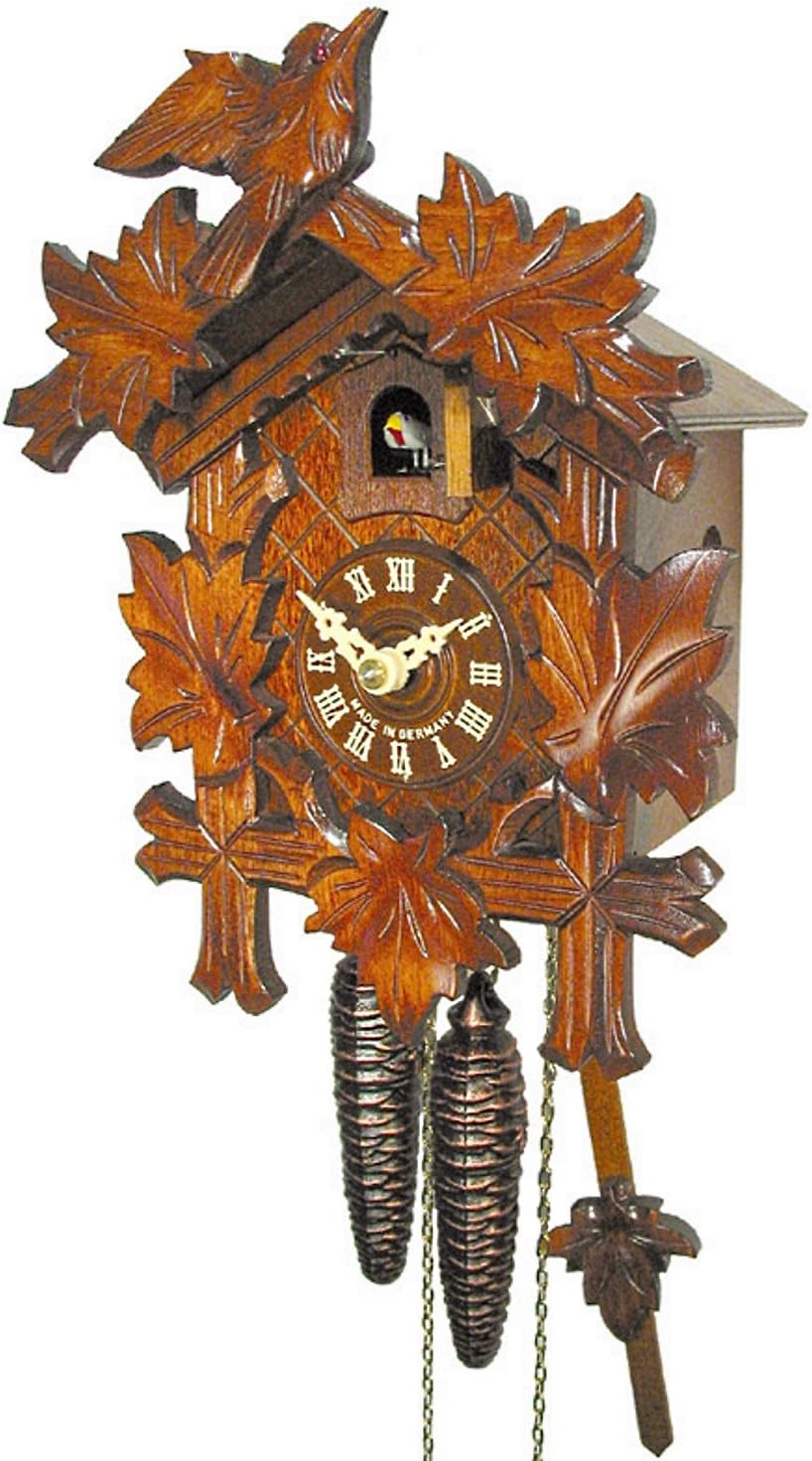
You’re looking at a cuckoo clock — small carved bird, pine cone weights hanging on chains, chalet or hunting motif on the case. It’s charming, it feels German, and the price seems reasonable. But here’s the thing: a large share of cuckoo clocks sold in gift shops and on major retail platforms worldwide are manufactured entirely in Asia, finished with machine-pressed plastic carvings, and fitted with battery-powered quartz movements. They look, at a glance, almost identical to clocks made by hand in the Black Forest region of southwestern Germany. The difference in long-term value, repairability, and resale price is enormous. This guide is for the buyer who already knows what a cuckoo clock is and is now trying to make a confident, well-informed purchase decision — whether that’s a $200 gift or a $1,500 heirloom. We’ll walk through the certification labels that matter, the two main movement types and what they tell you, and the maker signals that distinguish serious regional craft from mass-market production.
| EDITOR'S PICKCuckoo Clock - First Kiss | Mid-tierTrenkle Quartz Cuckoo Clock wit… | Budget pickOne Day Hand-Carved Cuckoo Cloc… | |
|---|---|---|---|
| Movement | — | Quartz | — |
| Music | — | ✓ | — |
| Leaves | — | 7 | Five |
| Birds | — | 3 | One |
| Height | — | — | 9 in |
| Model # | — | TU 369 QMT HZZG | 11-09 |
| Price | $1,575.72 | $413.59 | $259.27 |
| See on Amazon → | See on Amazon → | See on Amazon → |
The VdS Label: What It Means and What It Doesn’t Guarantee
The single most important document to look for when evaluating an authentic Black Forest cuckoo clock is the VdS certification — issued by the Verein die Schwarzwälder Uhrmacher, the Association of Black Forest Clockmakers. Per that organization’s published certification standards, a clock bearing the VdS “Original Black Forest Clock” seal must meet several hard requirements: it must be designed and manufactured in the Black Forest region of Germany, the movement (the internal mechanical works) must be produced in the region, and the clock must be assembled there by trained craftspeople.
This is a meaningful standard. The VdS is not a rubber stamp — per DW’s reporting on the Black Forest clock industry, the association actively monitors compliance and the label cannot be self-applied; clocks are reviewed against regional-origin criteria before certification is granted.
What the label tells you:
- The movement is genuinely Black Forest-made
- Regional craft labor was involved in assembly
- The clock is eligible for warranty and service support from the original workshop
What the label does not tell you:
- That every carved element is hand-cut (some certified clocks use machine-assisted carving for decorative elements; the distinction matters more as you move into the $800+ tier)
- That the clock is a top-tier movement — VdS certification applies across a quality range, from entry-level mechanical movements to premium eight-day pieces
The practical implication: if a listing does not explicitly mention VdS certification and cannot produce an included certificate card, you are buying on faith. Reputable retailers of genuine Black Forest clocks — including brands like Rombach & Haas, Hekas, Anton Schneider, and Kahlert — include the VdS certificate with every qualifying clock. If it’s missing from the product description, ask. If the seller doesn’t know what VdS means, treat that as a serious red flag.
Movement Types: The Decision That Drives Everything Else
The movement is the engine of the clock — the internal mechanical system that tracks time and triggers the cuckoo. For Black Forest clocks, there are two main categories, and your choice between them is the most consequential decision you’ll make.
1-Day Movement
A 1-day movement (also called a 24-hour movement) runs on weights — typically cast iron, often shaped like pine cones for traditional-style clocks. You wind the clock by pulling the chains to raise the weights once every day. The mechanism is relatively simple, which keeps costs lower and makes servicing straightforward.
Per the Schwarzwald Tourismus GmbH’s published overview of Black Forest cuckoo clocks, 1-day movements are the standard entry point for mechanical Black Forest clocks. At reputable makers, they typically power clocks in the $150–$500 range. They are fully repairable, parts remain available from regional clockmakers, and a well-maintained 1-day clock can run for generations.
8-Day Movement
An 8-day movement runs for a full week (roughly eight days) on a single winding. The mechanism is more complex — more gears, stronger mainspring tension, heavier weights. This increased mechanical complexity means higher production cost, better power regulation (which generally means more accurate timekeeping), and a clock that is engineered for longer service intervals.
Eight-day movements are the standard for mid-to-high-tier collectors. Clocks by Rombach & Haas, Hekas, and the upper lines from Anton Schneider typically run 8-day movements. Expect to pay $400–$600 at minimum for a 8-day mechanical from a certified Black Forest maker; hand-carved pieces with complex musical functions can run $1,200–$2,000+.
A note on quartz movements: Battery-powered quartz cuckoo clocks exist at all price points. They keep accurate time, require no winding, and some are made in Germany. However, quartz movements are generally not repairable in the same way mechanical movements are — when they fail, the movement is replaced rather than serviced. For buyers focused on heirloom value and long-term investment, mechanical movements are the clear preference. Quartz pieces from certified makers can still carry VdS labels if all other regional-origin criteria are met, so don’t assume VdS = mechanical. Read the spec.
By the Numbers
| Movement Type | Winding Frequency | Typical Price Range (VdS-Certified) | Serviceability |
|---|---|---|---|
| 1-Day Mechanical | Daily | $150 – $500 | High — parts widely available |
| 8-Day Mechanical | Weekly | $400 – $2,000+ | High — parts available from maker |
| Quartz | Battery (1–2 yrs) | $80 – $400 | Moderate — movement replaced, not repaired |
Maker Marks and What the Regional Craft Hierarchy Looks Like
Beyond VdS certification and movement type, the specific maker matters — both for quality assurance and for secondary market value. The Black Forest clockmaking industry is concentrated in a relatively small geographic area (roughly the districts of Schwarzwald-Baar, Ortenaukreis, and Freudenstadt), and the leading ateliers are well-documented in collector literature.
Rombach & Haas (based in Schonach) is among the most cited examples of a manufacturer that combines traditional Black Forest movement production with contemporary and highly traditional design. Per germanculture.com.ua’s coverage of Black Forest craft traditions, Rombach & Haas clocks are consistently referenced as benchmark pieces for authenticity and mechanical quality. Their clocks appear in the secondary auction market with stable or appreciating values, which the Smithsonian Magazine’s feature on cuckoo clock history notes as relatively rare in the decorative clock category.
Hekas (Hekasform GmbH, also Black Forest-based) occupies a similar tier, with an emphasis on hand-carved cases. The distinction between Hekas and Rombach & Haas is largely aesthetic — both use high-quality movements, both carry VdS certification, and both are considered collector-grade.
Anton Schneider is a frequently recommended mid-range maker. Per DW’s industry reporting, Anton Schneider produces a broad line from accessible mechanical pieces to higher-end carved models, making them a strong choice for buyers who want confirmed German provenance without entering the $1,000+ collector tier.
Kahlert specializes in smaller-format and musical-movement clocks, popular as gifts. Their pieces are reliably certified and mechanically sound; they’re less likely to appreciate significantly as investment pieces but represent excellent value at the $200–$400 tier.
What the maker’s mark looks like in practice: Genuine Black Forest clocks from certified makers ship with a paper VdS certificate (often a card or booklet, typically bilingual German/English), a maker’s plate or sticker on the clock back or interior, and a serial number traceable to the workshop. If a listing shows none of these elements, approach with skepticism regardless of what the product title claims.
Spotting the Look-Alikes: Five Signals Worth Checking
You don’t need to be a horologist to identify mass-market imitations. Reviewers and collectors who document their purchases across multiple platforms consistently flag the same distinguishing signals.
1. Weight of the weights. Real mechanical Black Forest clocks use cast iron or zinc-alloy weights. They are heavy for their size. Plastic-encased or hollow weights that feel light are a production shortcut common in Asian-manufactured pieces, even those sold under vaguely German-sounding brand names.
2. Carving texture and depth. Hand-carved and machine-carved wood look different under close examination. Genuine hand-carved elements — leaves, animals, deer antlers — show slight asymmetry and tool marks. Machine-pressed or injected resin ornaments have perfect regularity and a slightly waxy surface texture. The Smithsonian Magazine’s coverage of Black Forest craft notes that distinguishing hand vs. machine carving is a key skill for buyers at the collector tier.
3. Movement sound. A genuine mechanical cuckoo clock produces a deliberate, rhythmic tick from the escapement — the component that regulates gear movement. The sound should be even and relatively loud for its size. Quartz imitations have either no tick or a very faint, electronic approximation. If a seller claims mechanical movement but the clock ticks very quietly or inconsistently, ask for video proof of the weights and chain system in operation.
4. Country of origin labeling. Under U.S. import law, products must be labeled with country of origin. A clock labeled “Germany” or “Made in Germany” should mean what it says. However, per DW’s reporting, “Designed in Germany, assembled elsewhere” language has appeared in some marketing — this does not meet the standard for VdS certification and is not equivalent to Black Forest manufacture.
5. Price as a signal (but not a guarantee). A genuine mechanical Black Forest clock from a certified maker retails at a minimum of roughly $150–$200 at the lowest end of the 1-day movement range. Clocks priced under $100 and claiming to be authentic Black Forest mechanical pieces are, based on current manufacturer pricing and regional labor costs, almost certainly not what they claim. Price alone doesn’t confirm authenticity, but extreme low pricing nearly always rules it out.
The Decision Rule
If you’re making a purchase decision right now, here’s the clearest framework we can offer based on our research:
-
If the listing includes a VdS certificate, names a recognized Black Forest maker (Rombach & Haas, Hekas, Anton Schneider, Kahlert), specifies mechanical movement type (1-day or 8-day), and is priced consistently with regional production costs — you are almost certainly looking at a genuine piece. Proceed with confidence.
-
If any one of those four elements is absent or vague — ask the seller to clarify before purchasing. Reputable retailers will answer these questions readily. Hesitation or vague answers are a signal.
-
If you’re buying at the $400+ collector tier and plan to hold the piece long-term — prioritize 8-day mechanical movement, hand-carved case (ask explicitly whether carving is hand- or machine-assisted), and a maker with a documented secondary market presence. Rombach & Haas and Hekas are the names that appear most consistently in collector-grade discussions.
The cuckoo clock market is not free of confusion, and the look-alikes have become convincingly good. But the signals are readable — and once you know what to look for, the difference between a $90 import and a $600 Black Forest original is visible before you ever hear the bird call.