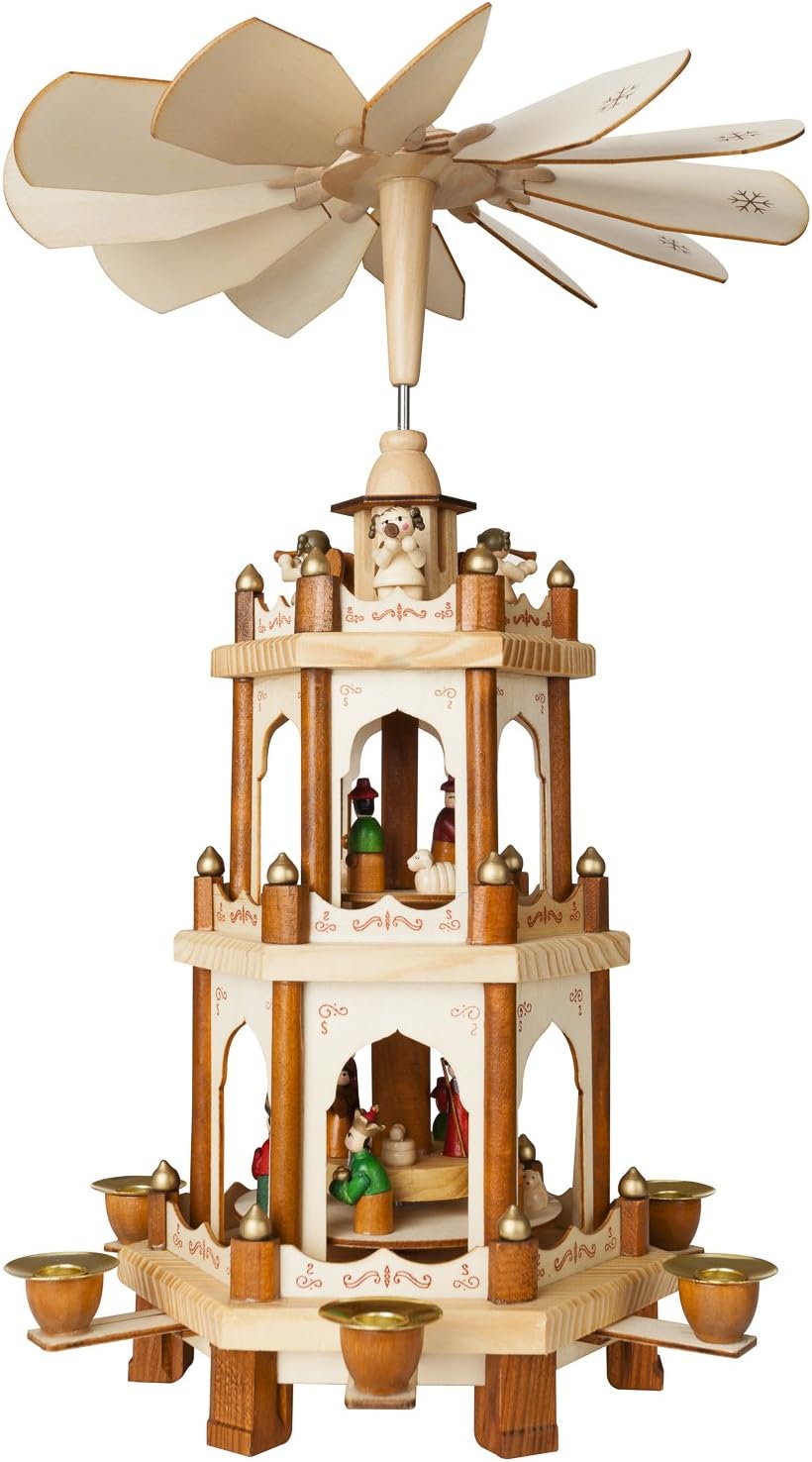
A Christmas pyramid — Weihnachtspyramide in German — is a tiered wooden carousel, usually two to four stories tall, decorated with hand-painted figures of nativity scenes, miners, angels, or forest animals. Candles mounted on its base generate rising warm air, which pushes fan blades at the top and sets the whole thing spinning in a slow, hypnotic rotation. They come from the Erzgebirge (AIR-tsge-BIHR-guh), a mountain range on the German-Czech border with centuries of woodcarving heritage, and they are one of the most iconic objects in German Christmas folk art. As DW’s 2021 feature on Erzgebirge traditions notes, the design descends from miners’ lanterns and was already a fixture in Saxon households by the early 1800s.
If you’ve recently bought one — or are about to — this guide is for you. Across hundreds of buyer reviews aggregated from authenticated purchasers, the same frustrations surface again and again: the pyramid arrives without candles, the instructions skip a crucial assembly step, or the carousel barely twitches even with four flames burning. None of these problems are inevitable. Most are predictable. What follows is a frank breakdown of what goes wrong, what the physics actually require, and how to buy or repair a pyramid with realistic expectations.
| EDITOR'S PICK[Hubrig - Folk Art Pyramids Gran…](https://www.amazon.com/dp/B000KJPCIQ?tag=greenflower20-20) | Mid-tier[Müller German christmas pyramid…](https://www.amazon.com/dp/B01K6RM0H2?tag=greenflower20-20) | Budget pick[BRUBAKER Wooden Christmas Pyram…](https://www.amazon.com/dp/B0047TB14Y?tag=greenflower20-20) | |
|---|---|---|---|
| Height | 35 cm | 30 cm | 18 in |
| Width | 25 cm | — | — |
| Tiers | — | — | 3 |
| Figurines | — | 4 | — |
| Theme | — | Angels | Nativity |
| Origin | — | Erzgebirge | — |
| Price | $339.15 | $152.15 | $84.86 |
| See on Amazon → | See on Amazon → | See on Amazon → |
The Physics First: Why Candle Heat Is Non-Negotiable
The pyramid is not a decorative object that happens to spin. It is a heat engine — specifically a convection-driven turbine. Warm air rises from the candle flames, strikes angled fan blades at the apex, and converts thermal energy into rotational force. The Smithsonian Magazine’s holiday folk-art feature describes the mechanism as functionally identical to the “whirligig” principle used in European mine ventilation centuries before electric fans existed.
This matters for buying decisions because the physics sets hard minimum thresholds:
By the numbers:
- Standard pyramid candles are typically 12–14 mm in diameter and 100–120 mm tall
- A 3-tier, 18-inch pyramid generally requires 4 candles producing roughly 40–50 watts of combined heat to spin reliably
- Larger 4-tier, 24-inch models often need 6 candles and generate proportionally more heat at the fan
- Fan blade pitch angle — typically 30–45 degrees on quality German pieces — determines how efficiently heat converts to rotation
When a pyramid spins slowly or not at all, the answer is almost always one of three things: insufficient heat input, too much friction in the axle, or a fan-blade pitch that’s been bent or damaged. Knowing which one you’re dealing with changes the fix entirely.
The Tea Light Problem (and Why It Keeps Causing Grief)
This is the single most common frustration in buyer reviews, and it deserves a direct answer: standard tea lights are not adequate to power most Christmas pyramids. They are too short, too wide, and too cool.
Tea light adapters — brass holders that let you substitute a flat tea light for a tapered pyramid candle — exist and are widely sold. One long-running reviewer, documenting a decade of struggle with a converted pyramid, confirmed explicitly that switching back to proper brass candle holders with tapered candles solved the spinning problem immediately after ten years of intermittent failure. That’s not an edge case; it’s a pattern.
The Spruce’s care guide for Christmas pyramids notes that purpose-made pyramid candles burn hotter and more centrally than tea lights, and that the heat column needs to rise directly through the candle ring toward the fan blades. A tea light’s flame sits lower, wider, and cooler — it diffuses heat laterally rather than directing it upward. For a small, 1-tier tabletop pyramid (around 10–12 inches), a tea light sometimes works if conditions are ideal: no draft, warm room, very little axle friction. For anything taller, it’s a frustrating gamble.
The tradeoff is real: tapered pyramid candles are a consumable cost. A set of 20 typically runs $8–$15 depending on brand and diameter, and a full evening’s burn consumes 2–4 candles. If you run your pyramid nightly through Advent, budget accordingly. But the alternative — a beautiful $200 piece sitting motionless on your mantle — is worse.
Assembly Gaps: The Instruction Problem
Multiple buyer accounts across pyramid models surface an identical complaint: the included instructions omit steps that turn out to be critical. One specific BRUBAKER Holy House reviewer documented this precisely — the base assembly involves bottom pieces that aren’t mentioned anywhere in the manual but are essential for the structure to sit level and for the axle to align correctly. An unlevel pyramid means the central rod binds, which adds friction, which means the heat that should be spinning the fan is instead fighting axle resistance.
What to do before you light anything:
- Fully assemble on a known-flat surface — use a small level if you have one
- Spin the top fan by hand before lighting candles; it should rotate freely with almost no resistance
- Check that the axle rod seats fully in the base socket and isn’t canted to one side
- Inspect each tier’s alignment — figures that hang too far outward add rotational drag
The Atlas Obscura profile of Erzgebirge craftsmanship notes that traditional master carvers hand-fit each axle to its housing, meaning tolerances are tight and alignment matters. Mass-market pieces often lack that precision fit, which makes correct assembly even more consequential.
Packaging, Damage, and What “Fragile” Actually Means
A recurring heartbreak in reviews of higher-priced pieces is damage on arrival — specifically broken figures on pyramids in the $300–$500+ range. The Hubrig Grandmother’s Christmas House has attracted several such accounts, with reviewers describing inadequate inner packaging that allows figures to contact hard surfaces during shipping.
This is a buying-channel issue as much as a product issue. Authentic Erzgebirge pieces from established ateliers like Hubrig, Dregeno, and KWO are made from linden wood with hand-painted finishes — they’re not fragile in the way glass is, but sharp impacts can snap thin limbs or chip paint on detailed figures.
If you’re spending $300 or more:
- Buy from a retailer that explicitly photographs or describes their packing method
- Look for double-boxing confirmation (outer shipping box + inner product box with formed foam or tissue)
- Document the exterior box condition before opening — if the outer box shows impact damage, photograph it before unwrapping anything
- Most legitimate retailers will replace damaged figures; having documentation makes the claim straightforward
The contrast is instructive: Erzgebirge-Palast 1-tier pyramids consistently receive positive reviews specifically citing safe arrival and easy spin — suggesting that packaging standards and product-appropriate sizing are directly correlated with buyer satisfaction. Smaller, simpler pieces are inherently lower-risk to ship. Larger, more complex ones require better protection.
Slow Spinning: When “Wrong” Is Actually Right
Here is the most important buyer-education point in this entire guide: slow spinning is often correct and intentional.
A Dregeno Seiffen deer pyramid reviewer put it well, explaining to fellow buyers that the pyramid “is not a fan” — it’s a folk-art object with a gentle rotation that mirrors candlelight, not a mechanical toy designed for speed. Traditional Erzgebirge pyramids, as described in the Erzgebirge Tourism Board’s documentation of regional woodcraft, rotate at roughly one full revolution per 30–60 seconds under normal conditions. That pace is a feature, not a defect.
The distinction matters for diagnosis:
- Slow but consistent rotation = the pyramid is working correctly
- Stops, starts, stutters = likely axle friction or uneven candle placement
- No movement at all = heat deficit (tea lights, too few candles, heavy draft) or mechanical bind
- Spinning fast = unusual; check that the fan blades haven’t been bent to too steep an angle
If yours rotates slowly and steadily with the correct candles, leave it alone. Enjoy it.
What Breaks and What You Can Fix
The Erzgebirge craft tradition has always built repair into the product logic — these are designed as multi-generational objects. Per the Deutsches Uhrenmuseum Glashütte’s exhibition notes on German folk craft, the assumption was always that a well-made wooden piece would outlast its original owner and be repaired rather than replaced.
Most-common failure points:
- Axle rod bending: Thin steel or brass rods can bend during shipping or from being stored incorrectly. Replacement rods are available from specialty retailers and are usually sold by diameter (typically 3–4 mm) and length.
- Candle holder brass cups: These corrode or crack after years of heat cycling. Replacement sets in correct diameters are the single most effective repair for pyramids that have stopped spinning reliably.
- Fan blades: Linden wood blades can warp with humidity changes. Minor warping can sometimes be corrected by lightly dampening and re-bending; significant warping usually requires a replacement fan assembly.
- Figure limbs: Small painted limbs (shepherd’s crooks, angel wings) are the most fragile element. Specialty German folk-art repair shops carry figure parts, and several Erzgebirge importers stock replacement figures for their catalog pieces.
The repair-kit reviewer who confirmed that new brass candle holders solved a decade-long tea light problem is a useful benchmark: if your pyramid was working once and has degraded, start with the holders before assuming the mechanism is broken.
Frequently Asked Questions
What size or type of candles do Christmas pyramids require, and where can I buy them? Most pyramids use tapered candles 12–14 mm in diameter (sometimes marked as “Euro size” or “pyramid candle size”). Standard birthday candles are too thin; household tapers are usually too wide. Specialty German import shops, some holiday décor retailers, and the same sellers who stock pyramid accessories carry correct sizes. Always verify the diameter against your candle ring before ordering.
Why is my pyramid spinning very slowly — is that normal? Usually yes. Traditional Erzgebirge pyramids complete roughly one rotation per 30–60 seconds. That pace is intentional and correct. If the rotation is consistent, it’s working as designed.
My pyramid won’t spin at all even with candles lit — what should I check first? Check in this order: (1) Are you using proper pyramid candles, not tea lights? (2) Is the axle rod seated straight and spinning freely by hand? (3) Is the pyramid level? (4) Is there a draft in the room? Eliminate each variable before assuming the mechanism is broken.
Are tea light candles strong enough to power a pyramid, or do I need tapered candles? For most pyramids — especially anything taller than 10–12 inches or with multiple tiers — tea lights are not adequate. They burn too cool and too low to generate sufficient upward heat. Tapered pyramid candles are strongly recommended.
Can I leave a Christmas pyramid up year-round, and is it safe with candles? Wood and paint hold up year-round in stable indoor environments; humidity extremes (very dry or very damp rooms) are a bigger risk than time. For candle safety, never leave a lit pyramid unattended, keep it away from curtains and overhead objects, and extinguish before leaving the room. The Spruce’s pyramid care guide recommends a dedicated candle-safe surface and a clear overhead clearance of at least 12 inches.
What parts are most likely to break on a pyramid and can they be replaced? Candle holders, the central axle rod, and fan blades are the highest-failure components — and all three are replaceable. Many Erzgebirge importers sell replacement part kits. For figures, contact the original retailer or a specialist in German folk-art restoration.
The Decision Rule
If you’re choosing between pyramids right now, here is the honest framework:
- If you want reliable first-use success: Choose a smaller 1-tier or 2-tier piece from an established Erzgebirge maker, buy purpose-made candles at the same time, and confirm the retailer double-boxes fragile pieces.
- If you’re investing $300+: Treat packaging documentation as non-negotiable. Verify the candle holder diameter before the piece arrives. Have a spare axle rod on hand.
- If you’re troubleshooting a pyramid you already own: Replace tea lights with proper pyramid candles first. If that doesn’t solve it, check axle alignment before assuming the worst. Most decade-old pyramids that have stopped spinning need a $12 set of brass candle holders, not a replacement.
The pyramid is one of the most durable objects in German folk art — designed to be handed down, repaired, and lit again. The frustrations buyers hit are almost always solvable. They’re just not explained in the box.