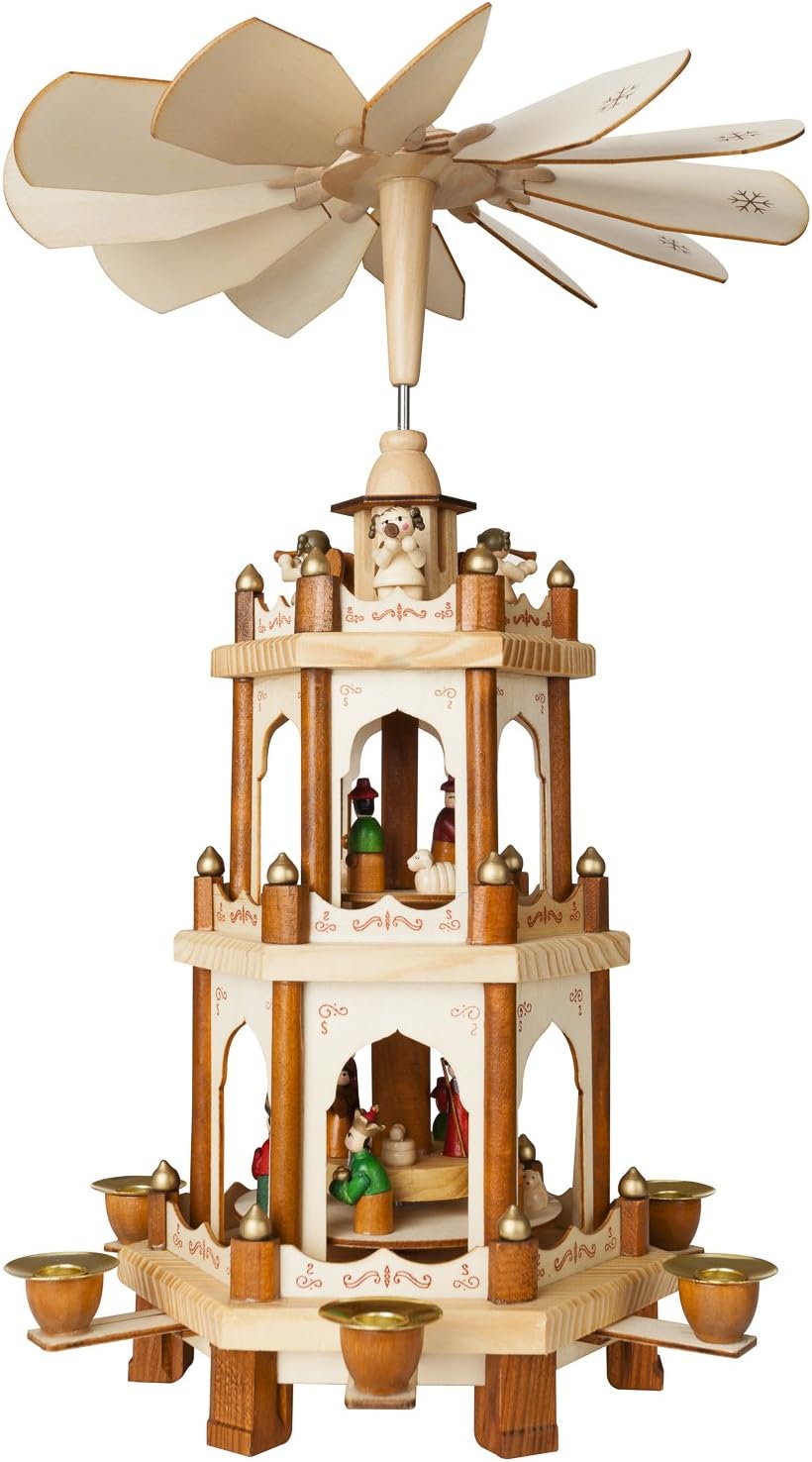
A German Christmas pyramid — Weihnachtspyramide in the original — is a tiered wooden carousel, usually with nativity or forest scenes arranged on rotating platforms, driven entirely by the heat from candles placed at its base. No batteries, no motor, no plug. Hot air rising from the candle flames strikes angled fan blades at the top of a central shaft, and that gentle push is all it takes to spin the figures around. It’s one of the oldest continuously produced folk-art traditions in the Erzgebirge (AIR-ts-guh-BIR-guh) mountain region of eastern Germany, documented as far back as the 18th century according to Erzgebirge-Tourismus e.V.’s overview of regional woodcraft heritage. When it works, it’s quietly magical. When it doesn’t spin, it’s quietly maddening — and the fix almost always comes down to one of a handful of very fixable variables.
This guide is for the buyer who already has a pyramid in hand — assembled, candles lit, and nothing moving. We’ll work through the most common failure modes in order of likelihood, show you the math on heat physics, and close with clear decision rules for replacement parts.
| EDITOR'S PICKHubrig - Folk Art Pyramids Gran… | Mid-tierMüller German christmas pyramid… | Budget pickBRUBAKER Wooden Christmas Pyram… | |
|---|---|---|---|
| Height | 35 cm | 30 cm / 12 in | 18 in |
| Tiers | — | — | 3 |
| Figurines | — | 4 | — |
| Theme | Christmas house | Angels | Nativity |
| Finish | — | Natural | — |
| Origin claimed | — | Erzgebirge | — |
| Price | $339.15 | $152.15 | $84.86 |
| See on Amazon → | See on Amazon → | See on Amazon → |
Why Thermodynamics Is Your First Diagnostic Tool
The pyramid’s spin mechanism is a convection engine. Candle flames produce a column of rising hot air; that column has to be concentrated and directed at the fan blades with enough force to overcome the shaft’s rotational friction. When any variable in that chain is off, the shaft stalls.
The four variables that control spin:
- Heat output — how many BTUs the candles actually produce
- Proximity — how close the flame tips are to the fan blade perimeter
- Drafts — ambient air movement that dissipates the heat column before it reaches the blades
- Friction — bearing wear, warped shafts, or figurines snagging on lower tiers
Reviewers of the BRUBAKER Holy House pyramid have explicitly identified the proximity problem: the candle holders in that model position flames noticeably farther from the fan blade than traditional Erzgebirge designs do. This isn’t a defect so much as a tolerance issue — the candle holder inserts can often be shimmed upward, or a slightly taller replacement taper can close the gap without any modification to the pyramid itself.
By the numbers:
| Candle type | Approximate flame height | Typical heat column rise | Practical verdict |
|---|---|---|---|
| Standard 5/8” tapered (original spec) | 1.5–2 cm | Concentrated, vertical | Best for most pyramids |
| Short/stubby novelty taper | 0.8–1 cm | Diffuse | Often insufficient |
| Tea-light (votive) | Varies; wide, low flame | Spreads horizontally | Generally inadequate |
| Battery/LED “candle” | None | None | Will not spin the pyramid |
The tea-light issue deserves a direct statement: tea lights are designed to produce ambient warmth and gentle illumination across a wide horizontal surface. Their flame geometry is wrong for a convection chimney. One reviewer of a tea-light conversion kit described the product as something that “never worked well” for exactly this reason — the horizontal spread simply doesn’t generate the rising column you need. DW’s feature on Erzgebirge Christmas traditions confirms that the original design specification assumes narrow tapered candles, the same format used since the craft’s 18th-century origins.
The Step-by-Step Spin Diagnosis
Work through these in order before ordering replacement parts.
Step 1: Check your candles against spec. Most pyramids are designed for standard 5/8-inch diameter tapered candles, roughly 4–6 inches tall. If your candles are shorter, fatter, or a different diameter, swap them first. This resolves the problem in a significant share of “won’t spin” cases.
Step 2: Measure flame-to-blade clearance. With candles lit and the pyramid assembled, look straight down from above. The tips of the flames should be within roughly 1–2 cm of the fan blade’s lower edge. If they’re falling short, you have two options: source taller tapers (within the fire-safety margin of keeping flames below the blade level), or check whether the candle-holder inserts can be raised.
Step 3: Eliminate drafts. This is the most underdiagnosed variable. A ceiling fan running on its lowest setting, an HVAC vent aimed at the room, or even an open doorway can scatter the heat column. Move the pyramid to a still corner, or temporarily drape a light cloth around the base perimeter to test. If it starts spinning in the protected position, you’ve found your culprit.
Step 4: Let it warm up. A cold pyramid on a cold night needs time. The shaft, bearings, and wooden components all have slight thermal inertia. Owners of the Dregeno Seiffen single-tier deer pyramid — a widely reviewed entry-level Erzgebirge piece — report that “giving it some time to warm up” resolves apparent non-spinning; one longtime owner reframes the slow initial rotation as intentional, a design choice rather than a flaw. Five to ten minutes of candle heat before expecting full rotation speed is a reasonable baseline.
Step 5: Check for mechanical friction. Spin the shaft manually with candles unlit. It should turn with almost no resistance. If you feel snags or grinding, check for: figurines or their accessories leaning into adjacent tiers; a warped base platform that’s slightly off-level; or a shaft pin that’s worked loose and is rubbing against the tier platform. The Spruce’s guide to caring for German Christmas decorations notes that wooden pieces are humidity-sensitive and can warp slightly if stored in very dry or very damp conditions, which can bind the shaft.
Replacement Parts: What Fits What
This is where the practitioner-level detail lives, because the parts ecosystem is more fragmented than it should be.
Fan blades: Most Erzgebirge pyramids — including pieces from Hubrig, Dregeno Seiffen, and Erzgebirge-Palast — use a standardized shaft diameter of 8mm or 10mm, and fan blade assemblies are generally interchangeable within those two sizes. The brand name stamped on the box is less useful than the shaft diameter measurement. Measure before ordering.
Candle holders: The socket diameter is usually 5/8 inch (standard European taper) or, in some older German imports, a slightly narrower 1/2-inch format. Replacement holders are widely available as multi-packs. The critical specification is socket depth, not just diameter — a shallow socket will let a taper wobble and produce an off-axis flame that doesn’t heat the blade evenly.
The tea-light converter question: Converters exist that adapt standard candle sockets to accept tea lights, marketed primarily for safety-conscious buyers or households with small children. As noted above, they functionally compromise the spin mechanism. If fire safety is the concern, the better solution is battery-operated tapers with an actual flame-mimic heater element — not a standard LED flameless candle, which produces no heat and will not spin the pyramid under any circumstances.
Brand-specific notes:
- Hubrig pyramids use metric hardware throughout; replacement parts sourced from North American craft suppliers may need a size conversion check.
- Erzgebirge-Palast pieces, which reviewers consistently describe as spinning effortlessly right out of the box, appear to have tighter manufacturing tolerances on flame proximity — a useful benchmark when evaluating whether a repair has restored correct function.
- BRUBAKER (a German brand sold widely in the North American market) uses proprietary candle holder inserts that are not cross-compatible with traditional Erzgebirge socket standards without modification.
When the Problem Isn’t the Candles at All: Arrival Damage
A separate failure mode entirely: figurines that won’t spin because they’ve been knocked off their mounting posts during shipping, or that arrived already broken. Hubrig pyramid buyers have reported this specifically, with one describing the original packaging as “totally inadequate” for the delicate instruments and figures involved.
If your figures arrived damaged, the protocol is:
- Document with photographs before reassembling or discarding packaging.
- Contact the retailer within 48 hours — most reputable German-craft importers treat transit damage as a fulfillment issue, not a return.
- For reattachment of small wooden figures, archival-grade PVA (wood glue), not superglue, is the right tool. Superglue’s rigidity can cause the joint to crack under thermal expansion cycling.
The Atlas Obscura feature on Erzgebirge craft traditions notes that the most collectible pieces — signed editions, named-workshop production, numbered runs — are essentially irreplaceable from a collector standpoint if damaged, which makes the packaging quality question a genuine buying-decision variable, not just a complaint category.
Correct Spin Speed: How Do You Know It’s Right?
There’s no single universal RPM standard, but Erzgebirge-Tourismus e.V. documentation of traditional design intent describes a gentle, meditative rotation — not a fast spin. As a practical benchmark: one full rotation of the upper tier every 15–45 seconds is typical for a properly functioning single- or double-tier pyramid under four standard tapers. Multi-tier pyramids with heavier figurine loads will be on the slower end. If your pyramid is spinning faster than one rotation per 10 seconds, check that the shaft is properly seated and that no tier is missing its figurine weight.
Slower is almost always fine. Several longtime Dregeno Seiffen owners have specifically noted that the slow, stately pace of a traditional pyramid is part of its appeal — the Smithsonian Magazine’s coverage of Erzgebirge folk arts frames this unhurried quality as deliberate, rooted in the craft’s monastic and contemplative origins.
Frequently Asked Questions
Why won’t my Christmas pyramid spin even when the candles are lit? The most common causes, in order: candles too short or too far from the fan blade, ambient drafts disrupting the heat column, mechanical friction in the shaft, and — less often — a fan blade that’s been slightly bent out of alignment. Work through the step-by-step diagnosis above before ordering parts.
Can I use tea lights instead of tapered candles in my pyramid? Not effectively. Tea lights produce a wide, low flame that spreads heat horizontally rather than directing it upward at the fan blade. Owners and reviewers consistently report that tea-light converters do not generate sufficient spin. Standard 5/8-inch tapered candles are the correct format.
Which replacement candle holders and fan blades fit which pyramid brands? Measure shaft diameter (8mm or 10mm covers most Erzgebirge production) and candle socket diameter (usually 5/8 inch) rather than relying on brand matching. BRUBAKER uses proprietary inserts. Hubrig uses metric standards. Erzgebirge-Palast, Dregeno Seiffen, and most traditional workshop production is broadly cross-compatible within the two standard shaft sizes.
What should I do if figurines arrive broken? Photograph immediately, contact the retailer within 48 hours, and use PVA wood glue (not superglue) for reattachment. For signed or numbered collector editions, consult the retailer before any repair attempt — some insurers and warranty programs require professional restoration.
How do I know if my pyramid is spinning at the correct speed? One full rotation every 15–45 seconds under four standard tapers is the practical range for most single- and double-tier pyramids. Slower is fine and often intentional. Faster than one rotation per 10 seconds warrants a check on shaft seating and figurine load.
Are assembly instructions included with Erzgebirge pyramids? Typically yes, but quality varies significantly by importer. Several reviewers have noted that base-piece assembly — the platform that holds the candle holders — is sometimes omitted entirely from printed instructions even though it’s critical to correct candle positioning. If your instructions don’t address base-piece placement, position the candle holders so flames sit 1–2 cm below the fan blade’s lower edge as your working standard.