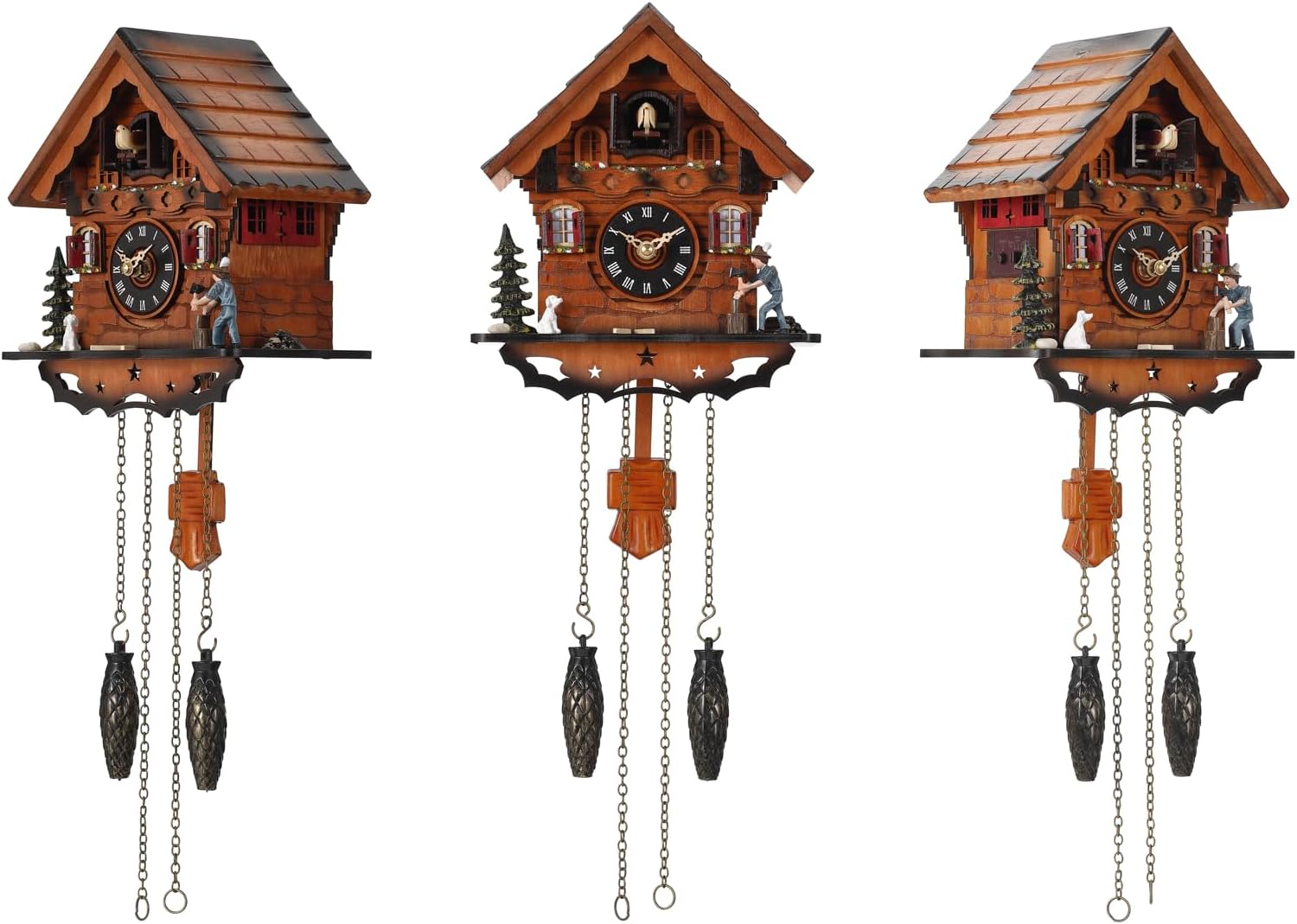
Cuckoo Clock Setup Frustrations Fixed: A Practical Troubleshooting Guide for New Owners
A cuckoo clock is exactly what it sounds like: a wall-mounted clock, typically carved from wood, that announces each hour (and sometimes each half-hour) with a small wooden bird that pops out of a door and calls “cuckoo.” They come in two broad types. Mechanical clocks are powered by hanging weights — cast-iron pinecone-shaped counterweights you pull down every one or eight days to wind the movement. Quartz clocks run on AA batteries and automate most of the magic electronically. Both types are sold across a wide price range, from decorative novelties to hand-carved collector pieces made in Germany’s Black Forest or Erzgebirge regions.
If you’ve just unboxed your first cuckoo clock and it stopped after 20 seconds, the bird won’t come out, or you’re staring at a pile of parts wondering what goes where — you’re not alone. These are the most-reported setup frustrations across dozens of owner reviews, and almost every one of them has a straightforward fix. This guide walks through each problem in order of how often it comes up, explains the why behind it, and tells you exactly what to do.
Why Your Clock Stops After a Few Seconds (The Leveling Problem)
This is, by a wide margin, the number-one complaint from new owners — and the fix is almost embarrassingly simple. A mechanical cuckoo clock’s movement is a precisely balanced gear system. When the clock is even slightly tilted, the pendulum (the decorative swinging piece at the bottom, usually shaped like a leaf or a carved motif) can’t swing in a full, even arc. The clock detects the imbalance almost immediately and stops.
The fix: Level the clock. Not “close enough” level — actually level. Owners consistently report that the difference between a clock that stops after 20 seconds and one that runs indefinitely is a matter of a few millimeters of tilt. Here’s the method that works:
- Hang the clock on its wall hook.
- Start the pendulum swinging gently side to side.
- Listen to the tick-tock. It should sound even — equal time between tick and tock. If one beat sounds faster than the other (“tick-TOCK… tick-TOCK”), the clock is not level.
- Tilt the clock slightly left or right — just a few millimeters at a time — until the beat sounds perfectly even.
- Mark the wall position and hang it there permanently.
The Spruce, in its cuckoo clock setup and maintenance guide (thespruce.com), confirms this “beat regulation” test as the standard diagnostic for any clock that stops unexpectedly. A spirit level helps, but your ears are the real tool here.
The pendulum attachment point is a related stumbling block. On many mechanical models — Hekas 8-day movements are a frequently cited example in owner forums — the pendulum doesn’t simply clip to an obvious hook. It attaches to a small, sometimes recessed wire hook inside or just below the clock body. Owners who discovered this hook after repeated stop-and-start failures describe it as the single biggest “aha” moment of setup. If your pendulum is swinging but the clock keeps stopping, check that it’s on the correct attachment point, not just resting against the case.
Getting the Cuckoo Bird to Emerge (and Stay in Sync)
The cuckoo bird is driven by a cam system — a rotating disc with a shaped edge that pushes the bird door open at the right moment. On quartz clocks, this is electronic. On mechanical clocks, it’s geared directly to the movement. Two separate problems show up here, and they have different fixes.
The Bird Doesn’t Come Out at All
On mechanical clocks, check that all shipping staples and foam blocks have been removed from inside the clock. Manufacturers brace the cuckoo door, bellows (the small accordion-shaped chambers that produce the call sound), and bird mechanism for transit. A single forgotten piece of foam can physically block the door. Owners of import models — particularly those arriving via freight carriers — have flagged this after carrier handling left packaging partially dislodged inside the case.
On quartz models, the cuckoo bird being reluctant to emerge fully is usually caused by the door tension spring being slightly overtightened from the factory. Gently opening and closing the cuckoo door by hand several times — essentially “breaking in” the hinge — resolves it in the majority of cases.
The Cuckoo Calls the Wrong Number of Times
This is a synchronization issue: the clock’s hands are pointing to 3:00 but the bird calls seven times. On quartz clocks, most models include an advance button — a small button, often on the back panel or near the battery compartment, that steps the cuckoo mechanism forward one call at a time without moving the hands. This feature is present on many entry-level quartz models but is frequently buried in documentation that buyers never locate. Press the advance button repeatedly until the cuckoo count matches the hour shown on the clock face.
On mechanical clocks, you synchronize by moving the minute hand manually forward to each hour and letting the cuckoo call before advancing to the next. Never move the minute hand backward — this can damage the cam mechanism.
Quartz Clock Battery and Light-Sensor Questions
By the numbers:
- Standard AA alkaline batteries: adequate for most quartz cuckoo clocks
- Recommended battery life: 12–18 months typical, per manufacturer specs
- Night shutoff light threshold: varies by model, typically around 5–10 lux
- Advance button cycles to sync cuckoo: usually 1–12 presses
Do You Need Special Batteries?
No. Standard AA alkaline batteries work in virtually every quartz cuckoo clock on the market. Lithium AA batteries will also work and last longer in cold environments, but they’re not required. What does matter: fresh batteries. A cuckoo clock’s mechanism draws a brief spike of current when the bird deploys. Batteries that read 80% depleted on a voltmeter may still fail to drive the mechanism through a full cuckoo cycle. If the bird is sluggish or the call sounds weak, replace the batteries before troubleshooting anything else.
Why Won’t It Call During the Day When There’s Light?
Almost every quartz cuckoo clock includes an automatic night shutoff — a light sensor, usually a small photocell on the clock face or back, that silences the cuckoo when ambient light drops below a threshold. This is a feature, not a malfunction. But it catches owners off guard in two scenarios:
-
Daytime silence in a dark room. If the clock is positioned against a wall away from windows, or if curtains are drawn, the sensor may read “night” even at 2 p.m. Solution: move the clock to a brighter wall position, or check whether your model has a manual override switch to disable the sensor entirely.
-
Calling all night unexpectedly. If a lamp or streetlight shines directly on the sensor, it will think it’s daytime. Redirect the light source or reposition the clock.
DW’s feature on Black Forest clockmaking traditions (dw.com, “The Art of the Cuckoo Clock”) notes that the night-silence mechanism became a standard feature as quartz movements democratized cuckoo clock ownership — it’s now effectively universal in battery-powered models.
Missing or Damaged Parts on Arrival: What to Do
Shipping damage is a genuine problem in this category. Owner reports across multiple models describe missing weights in damaged shipments, broken decorative elements (water wheels are a commonly cited casualty), and cases where the pendulum arrived detached from its hook with no instructions explaining how to reattach it.
Immediate steps when you unbox:
- Photograph everything before touching anything. Open the box, photograph the interior as received, then carefully unpack. This is your evidence if a carrier claim is needed.
- Inventory against the packing list. Most cuckoo clocks ship with: the clock body, one or more hanging weights (one-day mechanical = 1 weight, eight-day = 3 weights), a pendulum, a hanging hook, and a chain. Quartz models ship with fewer components but may include a decorative pendulum even though it’s not functionally required.
- Contact the seller immediately. Documented owner experience with broken decorative elements — a smashed water wheel being the most commonly reported item — is that a straightforward reorder or replacement request resolves the issue quickly, often within the same return window. Do not attempt to repair a structurally broken component yourself; doing so voids most seller warranties and the repair may not hold under normal use.
Smithsonian Magazine’s overview of Black Forest clockmaking heritage (smithsonianmag.com, “The Cuckoo Clock’s Long History”) notes that authentic German-made pieces carry paperwork — certificates of origin, VdS Schwarzwald labels, or maker’s marks stamped into the movement. The VdS Schwarzwald label is a regional authenticity designation administered by the Verband der Schwarzwälder Uhrmacher, and its presence is documented by Schwarzwald-Tourismus, the Black Forest Tourism Board (schwarzwald-tourismus.info). If any of this documentation is missing from a clock represented as German-made, that’s a separate concern worth raising with the seller before the return window closes.
Mechanical Clock Maintenance: The Winding Schedule
For owners of one-day mechanical clocks — the entry and mid-range mechanical tier — you pull the weights down every 24 hours. The chain connected to each weight is the clock’s power source; as the weight descends, it drives the movement. When the weight reaches the bottom, the clock stops. Pull it up before that happens.
Eight-day movements — found in higher-end pieces like Hekas, Rombach & Haas, and Anton Schneider clocks — need winding once per week. Atlas Obscura’s destination feature on the Black Forest region (atlasobscura.com, “The Black Forest: Home of the Cuckoo Clock”) identifies the eight-day movement as one of the key upgrades that distinguishes a collector-grade piece from a daily-use clock, precisely because the weekly winding schedule is less disruptive to household routine.
If the clock runs fine, do not oil it yourself. Owner-applied lubricants of the wrong viscosity are one of the most common causes of movement failure in otherwise healthy mechanical clocks. Schwarzwald-Tourismus documentation on authentic Black Forest clockmakers recommends professional service — cleaning and oiling — every 5–8 years for mechanical movements, performed by a qualified clockmaker.
Frequently Asked Questions
Why does my cuckoo clock stop running after a few seconds? Almost always a leveling issue. Listen for an uneven tick-tock beat and tilt the clock slightly until the rhythm is perfectly even. Also verify the pendulum is attached to the correct hook inside the clock body, not just resting against the case.
How do I get the cuckoo bird to come out at the right time? On quartz models, use the advance button (usually on the back panel) to step the cuckoo count forward until it matches the hour on the clock face. On mechanical models, advance the minute hand clockwise through each hour, letting the bird call at each one, until hands and cuckoo count are synchronized.
Do I need special batteries for a quartz cuckoo clock? No — standard AA alkaline batteries work fine. Replace them when the bird sounds sluggish or weak, even if the hands are still moving.
Why won’t my cuckoo call during the day when there’s plenty of light? The clock’s light sensor may be reading a dimly lit room as “night.” Reposition the clock on a brighter wall, or check for a manual override switch on the back panel to disable the automatic night shutoff.
What should I do if parts are missing or broken on arrival? Photograph the packaging before unpacking, inventory all parts against the packing list, and contact the seller immediately. Most reputable sellers resolve missing or damaged components within the standard return window. For clocks represented as German-made, also verify that authenticity documentation — VdS label, certificates, maker’s marks — is present. Missing paperwork is a separate issue worth addressing before the return window closes.
How often do I need to pull the weights on a one-day mechanical clock? Every day — ideally at the same time each day, before the weight reaches the bottom. Eight-day movements need winding once per week.
The honest summary: cuckoo clocks reward patience at setup and punish shortcuts. The leveling step alone resolves the majority of stop complaints, and the advance-button sync fixes most cuckoo-count frustrations. If you’ve worked through both and the clock still misbehaves, longtime owners of mid-range mechanical pieces consistently note that finding the precise wall position — sometimes moving the clock just a centimeter in either direction — was the turning point. That’s the right frame. Get the level right, get the pendulum on its hook, and these clocks will run for decades.