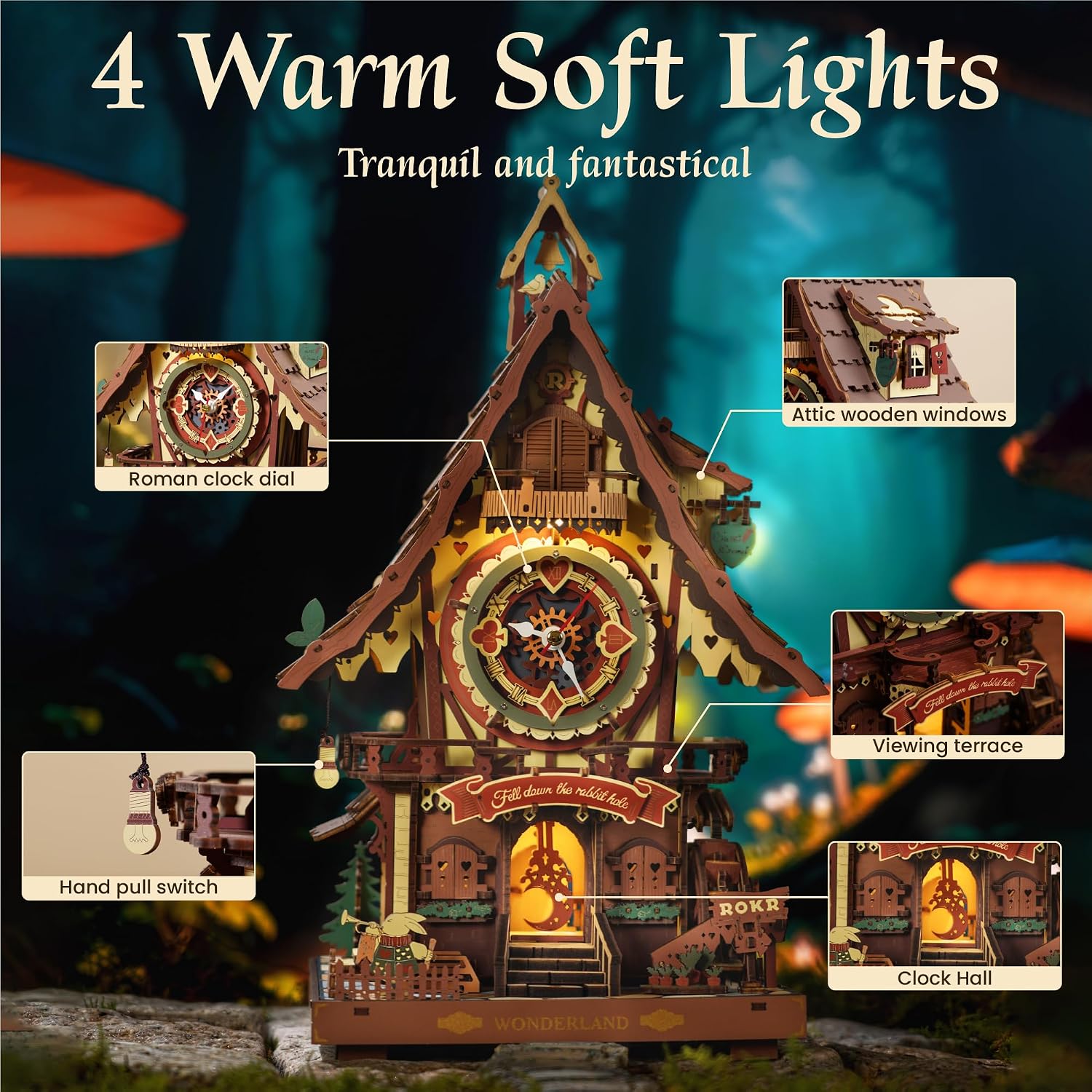
If you’ve ever admired a cuckoo clock — those carved wooden timepieces where a tiny bird pops out on the hour to announce the time — but weren’t quite ready to drop $200 on an imported heirloom piece, there’s a middle path worth knowing about. Wooden mechanical puzzle kits from brands like ROKR and ROBOTIME let you build a working, gear-driven clock entirely from laser-cut wooden pieces that press and lock together, usually without glue. The finished object isn’t just a decoration; it’s a small mechanical system you assembled yourself, which makes it a genuinely different kind of gift than anything you can pull off a shelf. This guide is written for gift-givers, collectors, and enthusiasts who already know the broad landscape of German-style decorative clocks and want a clear-eyed look at how these kits fit — or don’t fit — into that world.
| EDITOR'S PICKROBOTIME 3D Wooden Puzzles for… | Mid-tierROKR 3D Wooden Puzzles for Adul… | Budget pickROKR 3D Puzzles for Adults Vint… | |
|---|---|---|---|
| Kit type | Cuckoo clock | Cuckoo clock | Pendulum clock |
| Piece count | 435 | — | — |
| Lighting | 2 lights | — | — |
| Finished size | — | — | 12" |
| Movement | — | Mechanical | Mechanical |
| Display style | — | — | Wall clock |
| Price | $69.99 | $69.99 | $64.99 |
| See on Amazon → | See on Amazon → | See on Amazon → |
What These Kits Actually Are (and Aren’t)
Let’s name the tradeoff up front: a ROKR or ROBOTIME wooden clock puzzle is not a Black Forest cuckoo clock. It doesn’t carry a VdS Schwarzwald label (the official certification mark that guarantees a clock was made in the Black Forest region of Germany, with movements meeting defined craft standards). It won’t appreciate on the secondary market the way a signed Rombach & Haas piece might. Smithsonian Magazine’s overview of mechanical clock history notes that true Black Forest clockmaking traces to cottage-industry workshops in the 17th century — a lineage these Chinese-manufactured kits don’t share.
What they are is a precision-cut, assembly-driven activity product that results in a working mechanical or pendulum clock with genuine gear trains, escapements (the mechanism that controls the release of energy to keep time), and in some models, a functioning music box movement. The craft council community has increasingly documented this category — The Spruce Crafts’ roundup of 3D wooden puzzles names ROKR specifically as a brand that has moved the category from simple static puzzles toward kinetic, functional objects.
The audience split matters here. For the serious collector investing $400–$2,000 in a Rombach & Haas or Hekas piece, these kits are not a substitute — they’re a different product category entirely. But for the gift-giver looking for a $30–$80 item that delivers a hands-on experience of mechanical clockmaking, or for a Germanophile who wants to understand how a gear-and-escapement system works before they invest in the real thing, the kits are genuinely well-matched. Apartment Therapy has noted the broader trend of DIY experience kits outperforming static decorative gifts in recipient satisfaction — people remember what they built.
ROKR vs. ROBOTIME: Reading the Landscape
ROKR and ROBOTIME are the two dominant English-market brands in this space, and the relationship between them is worth clarifying before you buy. ROBOTIME is the parent manufacturer; ROKR is ROBOTIME’s premium sub-brand, positioned at slightly higher price points with more mechanically complex designs. Think of it the way you’d think of a carmaker with a luxury trim line — same factory heritage, different engineering ambition.
ROKR kits in the clock category typically run $35–$75 and are known for multi-component gear trains. The ROKR Cuckoo Clock (model LK503, widely reviewed across hobby communities) is the kit most directly evoking the Black Forest aesthetic: it includes a pendulum, a working cuckoo door mechanism, and a gear-driven hour hand. Across aggregated buyer reviews on major retail platforms, owners consistently report a build time of 4–7 hours and describe the gear-meshing phase as the most technically demanding step. The finished piece stands roughly 9 inches tall and uses a rubber-band tension system to power the movement — a clever substitution for the traditional pine-cone weights used in authentic German cuckoo clocks.
ROBOTIME’s mid-tier kits (roughly $20–$45) tend toward simpler clock faces and fewer moving components, making them a better fit for younger builders or gift recipients who want a satisfying two-to-three hour project rather than an engineering challenge. The ROBOTIME Vintage Radio Clock and several of their “Vintage Series” pieces incorporate clock faces without full working movements, which is worth flagging to buyers expecting functional timekeeping.
By the Numbers
| Brand / Model | Approx. Price Range | Build Time (reported) | Movement Type | Functional Timekeeping? |
|---|---|---|---|---|
| ROKR Cuckoo Clock LK503 | $45–$65 | 4–7 hours | Rubber-band gear train | Yes (hour hand) |
| ROKR Pendulum Clock | $35–$55 | 3–5 hours | Gravity pendulum | Yes |
| ROBOTIME Vintage Series (clock face models) | $20–$40 | 2–3 hours | Decorative / partial | Varies by model |
Prices reflect mid-2026 retail conditions; build times sourced from aggregated owner reviews.
Where These Kits Fit in a Collector-Adjacent Gift Strategy
Here’s the decision frame that matters for AlpineGifts readers specifically: these kits don’t compete with your heirloom inventory, but they do compete for occasion — the birthday, the Advent gift, the “I want to get them something German-themed but they don’t have a place for a full cuckoo clock” scenario.
DW’s feature on the Black Forest cuckoo clock as a German cultural icon notes that the clock’s appeal has always been partly about the story — the craftsmanship, the regional identity, the mechanical ingenuity of a hand-carved movement. A ROKR kit captures exactly the mechanical-ingenuity part of that story in a participatory format. For a gift recipient who is curious about clockmaking but not yet ready to commit to a $300–$600 investment, building a gear-train clock from scratch is genuinely educational. Atlas Obscura’s piece on Triberg — the Black Forest town that bills itself as the cuckoo clock capital of the world — describes the escapement mechanism as the beating heart of every clock; a ROKR builder will handle that escapement directly, which no amount of reading can replicate.
Pairing strategy for gift-givers: Consider bundling a ROKR Cuckoo Clock kit with a smaller authentic piece — a painted ornament, a Wendt & Kühn angel, or a set of Erzgebirge wooden figures. The kit becomes the “experience” component; the authentic piece becomes the lasting heirloom. This pairing hits a $65–$110 combined price point that over-delivers on perceived value and tells a coherent craft story without misrepresenting either item.
For corporate gift buyers and event stylists sourcing Christkindlmarkt-themed installations or Advent activations: ROKR kits work exceptionally well as participatory elements at holiday events — a build station where guests assemble a small wooden puzzle is a documented crowd engagement tactic. The kits are consistent in quality, ship flat, and carry enough visual cue (gears, wooden textures, clock aesthetics) to read as thematically German even to guests who couldn’t name the Black Forest on a map.
What to Watch Out For Before You Buy
Skill level honesty. ROKR markets these as “adult puzzles,” and that’s accurate — the LK503 cuckoo clock in particular requires careful attention to gear alignment. Owners in long-run reviews consistently note that rushing the rubber-band tension assembly is the most common failure point. If you’re buying for a recipient who isn’t patient with small-parts work, size down to a simpler ROBOTIME model or a non-clock ROKR kit.
“Cuckoo clock” framing in marketing. Some retailers describe these kits with language that could be read as implying Black Forest authenticity. They are not Black Forest clocks. They carry no VdS certification, no regional craft designation, and no movement hallmarks. If you’re buying for a serious collector who tracks maker marks and authenticity certificates, be explicit about what the kit is — a mechanically interesting craft project, not a collector piece.
Finish quality expectations. The laser-cut basswood used in these kits has a characteristic scorched-edge smell when first opened (from the cutting process) and a raw, natural-wood appearance. Owners report this fades within a few days. The finished object looks handsome but not polished in the way a lacquered German clock does — it reads as craft-project aesthetic, which is part of the charm for the right recipient and a mismatch for someone expecting a decorative showpiece.
Replacement parts. Because these kits use proprietary laser-cut components, a lost or damaged gear piece can be difficult to replace. ROKR maintains a customer service channel for replacement parts, but turnaround times reported by owners vary. This isn’t a dealbreaker, but it’s worth mentioning for gift-givers who worry about the recipient hitting a snag mid-build.
The Decision Rule
If your recipient is a hands-on builder, a mechanical-curiosity type, or someone who wants to understand how a clock works before investing in the real thing — the ROKR LK503 Cuckoo Clock is our research-backed top pick in this category. Owners consistently describe it as the most satisfying build in the ROKR clock lineup, and the cuckoo door mechanism gives it the most direct visual connection to Black Forest tradition.
If your recipient is a younger or less experienced builder, or if you want a lower-stakes entry point, a ROBOTIME Vintage Series clock-face model in the $25–$40 range delivers a good outcome with less frustration risk.
If you’re a corporate buyer or event stylist sourcing multiples for an installation or gift suite: ROKR’s pendulum clock models offer a cleaner build experience at volume (fewer tension-assembly variables than the cuckoo mechanism) and photograph well in styled flat-lay setups.
And if your recipient is a serious collector or someone who already owns authenticated Black Forest or Erzgebirge pieces: frame the kit explicitly as a complement, not a peer — a way to deepen their appreciation of the craft rather than a decorative investment. The story sells itself once it’s framed honestly.
The Black Forest tradition has always been about ingenuity — clockmakers who turned wood, gut string, and mechanical intuition into objects that kept time in farmhouses for generations. A ROKR kit doesn’t replicate that tradition, but it does let a curious person touch the same fundamental mechanics: the escapement, the gear train, the pendulum swing. For the right recipient, that’s not a consolation prize. It’s the whole point.