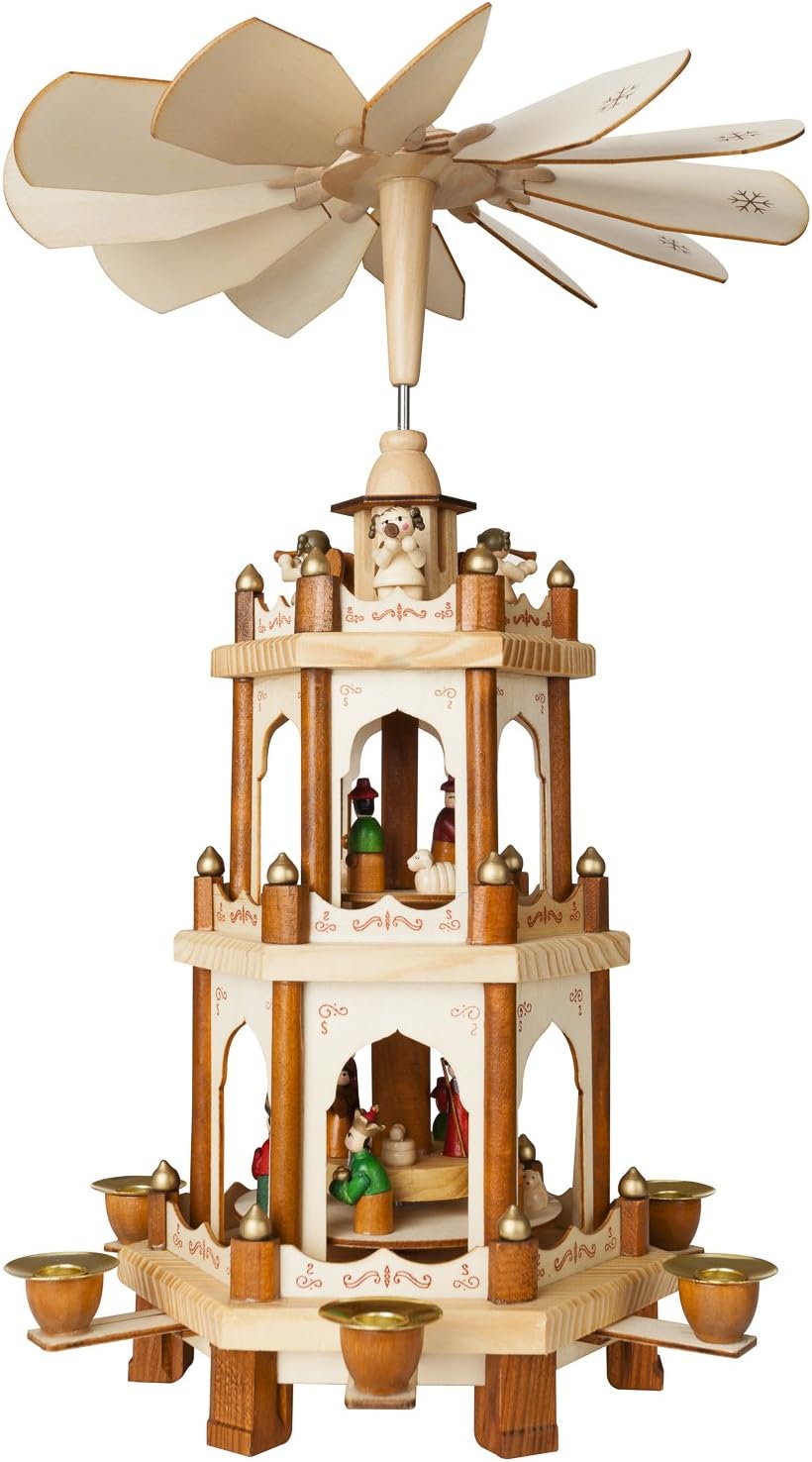
An Erzgebirge Christmas pyramid — Weihnachtspyramide in German — is a tiered wooden carousel, usually three or four stories tall, decorated with hand-carved figures: miners, angels, forest animals, and nativity scenes. Candles set into the base generate heat, which rises and turns a fan at the top, slowly spinning the tiers like a lazy Susan made of folklore. The tradition comes from the Erzgebirge (roughly “Ore Mountains”), a forested mountain range straddling the German-Czech border where, for centuries, miners carved wooden figures during the long winters to supplement their income. Today that craft heritage is protected and celebrated — and the pyramids are among the most recognized symbols of a German Christmas. If you’ve seen one glowing in a shop window and wondered whether it’s worth the investment, or you’re already at the point of comparing specific makers and trying to figure out what $150 gets you versus $600, this guide is built for that decision.
What You’re Actually Buying: The Anatomy of a Pyramid
Before you compare prices, it helps to understand what drives cost — because the gap between a $45 entry-level piece and a $450 regional atelier piece isn’t arbitrary. It maps to specific differences in materials, movement, and hand-labor.
The tiers and carvings. Most pyramids have two to four rotating platforms. Entry-level pieces use molded or laser-cut figures with painted details. Mid-range pieces shift to hand-finished figures with more dimensional carving. At the top end, figures are individually hand-carved and painted, often by artisans working within the Erzgebirge’s surviving cottage industry system — a structure described in detail by Atlas Obscura’s profile of the region as one where individual workshops still specialize in specific figure types, handing work between families.
The movement. The spinning mechanism is deceptively simple — a wooden or metal fan (called a flügel, or “wing”) catches the rising warm air from the candles and transfers rotation through a central shaft. Cheaper pieces use thin wooden fans that can warp; quality pieces use thicker-cut hardwood fans or hand-forged metal versions that turn more reliably over decades. This is the single most failure-prone component in a pyramid, and it’s worth examining closely in any purchase you’re considering.
The base and frame. Solid linden wood (a traditional Erzgebirge carving wood, soft enough to work cleanly, stable enough for long-term structure) versus MDF or pine composites — you’ll feel and see the difference. Linden has a characteristic pale, even grain; composites tend to show filler or edge irregularities at the joints.
Regional certification. The Erzgebirge region has a craft designation system — pieces produced in the traditional zone can carry regional provenance marks. As the Erzgebirge Tourism Board notes in its documentation on traditional woodcrafts, the “Echt Erzgebirge” (Genuine Erzgebirge) designation is awarded to products that meet regional origin and handcraft standards. This isn’t the same as a generic “Made in Germany” label, which a piece can carry even if its figures were finished elsewhere.
The Three Tiers: What You Get at Each Price Point
By the Numbers
| Tier | Typical Price Range | Figure Type | Movement | Regional Cert? |
|---|---|---|---|---|
| Entry / Novelty | $30–$90 | Molded, mass-painted | Thin wood fan | Rarely |
| Mid-Range | $100–$350 | Hand-finished, better detail | Hardwood fan | Sometimes |
| Collector / Atelier | $400–$1,200+ | Hand-carved, individually painted | Hardwood or metal | Yes, typically |
Entry tier ($30–$90). These are genuine decorative pieces — they spin, they glow, they look the part on a mantle. But they’re designed for seasonal use, not decades of handling. The figures have a sameness to them because they come from the same molds. If you’re buying for a child’s room, a first apartment, or as a festive gift where the price point matters more than provenance, this tier does the job. Don’t expect the movement to be whisper-smooth, and plan to be gentle with the figure placement.
Mid-range ($100–$350). This is where the decision gets genuinely interesting. Makers like Kahlert and some of the better-positioned import lines from the Erzgebirge region start here. You’re getting hand-finishing, more expressive figure painting, and noticeably better construction on the base and shaft. DW’s feature on the Erzgebirge region notes that many mid-range pieces still originate from small family operations in towns like Seiffen and Olbernhau, which matters for authenticity even when the pieces aren’t at the top of the price ladder.
This is also the tier where theme differentiation becomes real. You can find pyramids focused specifically on the mining heritage (figures in traditional miners’ costumes, with lanterns and tools), purely religious nativity arrangements, forest animal themes suited for non-denominational gifting, and more. The mid-range is worth spending time in, because a $200 pyramid from a legitimate Erzgebirge workshop will outlast and outshine a $400 piece from an import brand that uses regional aesthetics but manufactures elsewhere.
Collector / Atelier tier ($400–$1,200+). Above $400, you’re in a different conversation entirely. The benchmark makers at this level — KWO (Kunstgewerbe-Werkstätten Olbernhau), Wendt & Kühn for figures (though their specialty is the angel choir figurine), and dedicated pyramid workshops in Seiffen — produce pieces where the hand-carving is legible at arm’s length. Individual figures have distinct facial expressions. The turning motion is measured and quiet. The wood patina over time in a way that composites don’t.
KWO in particular has a long production history in the region. Smithsonian Magazine’s coverage of centuries-old Erzgebirge woodcraft cites the surviving workshops as living continuations of a tradition that predates modern manufacturing — a point that matters when you’re evaluating whether a piece holds or appreciates in secondary-market value. Signed or limited editions from established Erzgebirge workshops do appear at auction, though the market for pyramids is less liquid than for, say, signed Steinbach nutcrackers.
The “Echt Erzgebirge” certification at this tier is close to table stakes. If a piece above $400 doesn’t carry it or can’t be traced to a named regional workshop, that’s a meaningful red flag.
The Tradeoffs You Actually Have to Make
Regional cert vs. aesthetic fit. The certified pieces skew toward traditional motifs — miners, angels, the nativity, forest scenes. If you’re buying for a modern or minimalist interior where a deeply traditional piece would feel out of place, you may find the aesthetic fit better in the mid-range import market. That’s a legitimate tradeoff to make consciously, not a mistake. What you’re trading is the provenance story and long-term investment character for design flexibility.
Size vs. candle count vs. heat management. Larger pyramids (three to four tiers, 18–24 inches tall) typically require four candles. The more candles, the more heat differential, the smoother the spin — but also the more heat generated in the base area. Owners of larger pieces consistently note in aggregated reviews that positioning matters: pyramids placed on mantles with limited overhead clearance, or near curtains, need real attention. Smaller two-tier pieces (often in the $80–$150 range) run on fewer candles and are easier to manage in tighter spaces, but the spin is sometimes less reliable because there’s less thermal differential driving the fan.
Electric conversion vs. candle operation. Some makers now offer electric candle inserts — LED bases that simulate the candle glow and generate just enough gentle heat (or in some cases, a small motor) to turn the tiers. The German Culture resource on Erzgebirge traditions notes that purists consider candle-driven movement the authentic experience, but for households with small children or pets, electric versions offer real practical advantages. Electric conversions are available as aftermarket fits for many standard-size pyramids, typically in the $20–$40 range for compatible bases. If you know your display environment will make candle management difficult, factor this in at purchase rather than retrofitting later.
Display-only vs. annual use. If you’re buying as a collector piece to display in a case or on a permanent shelf (some serious Erzgebirge collectors display year-round rather than seasonally), the movement durability question is less pressing. But if you’re buying for annual Advent use — taking it out, operating it for four weeks, packing it away — the fan and shaft joints take cumulative stress, and the mid-to-upper end of each tier is worth the premium for construction resilience.
How to Evaluate a Specific Piece Before You Buy
When you’re looking at a specific pyramid — whether in a specialty retailer, at a Christkindlmarkt, or through a curated import source — run through this checklist:
-
Can you name the maker and their location? “Made in Germany” isn’t enough. Seiffen, Olbernhau, Annaberg-Buchholz — these are the towns. A named workshop is better than a brand name alone.
-
Does the fan move freely? If you can gently tap the shaft and watch the fan, do it. It should rotate with almost no resistance. A fan that catches or drags will struggle with real candle heat.
-
Are the figures individually placed or molded onto the tier? Removable, individually placed figures indicate hand-finishing. Figures molded directly into the rotating disc are mass-production indicators.
-
Is the “Echt Erzgebirge” seal present? For anything above $200, this should be part of the conversation. The Erzgebirge Tourism Board maintains the designation standards; the mark is a small printed seal, typically on the base or on accompanying documentation.
-
What’s the candle specification? Standard Erzgebirge candles are a specific diameter (roughly 14–16mm) — not standard taper candles. Your pyramid will almost certainly need the regional candles to fit properly. Confirm the spec and factor in supply cost.
The Decision Rule
If you’re still building your collection and this is your first pyramid: spend in the $150–$300 range, prioritize a named Erzgebirge workshop over brand marketing, and confirm the “Echt Erzgebirge” seal or equivalent regional documentation. This tier gives you an authentic, durable piece that will survive a decade of annual use and that you can resell or gift without embarrassment if your tastes change.
If you’ve already handled Erzgebirge pieces, know the figure styles you prefer, and are buying with a 20-year horizon: move to $400 and above, target KWO or a directly-sourced atelier piece, and treat the regional certification as non-negotiable. At this tier, you’re buying something that the secondary collector market will recognize and that family members will actually compete to inherit.
If your budget is genuinely under $100 and you just want the experience: buy the entry-level piece without guilt, enjoy it seasonally, and treat it as an on-ramp to the category rather than a permanent acquisition. There’s no shame in that path — most serious Erzgebirge collectors started somewhere modest and learned their preferences from living with a piece for a season or two.
The pyramid tradition has survived centuries of economic upheaval, regional border changes, and the collapse of the mining industry that originally gave rise to it, as documented in DW’s regional profile. A well-chosen piece will outlast the purchase decision anxiety considerably.