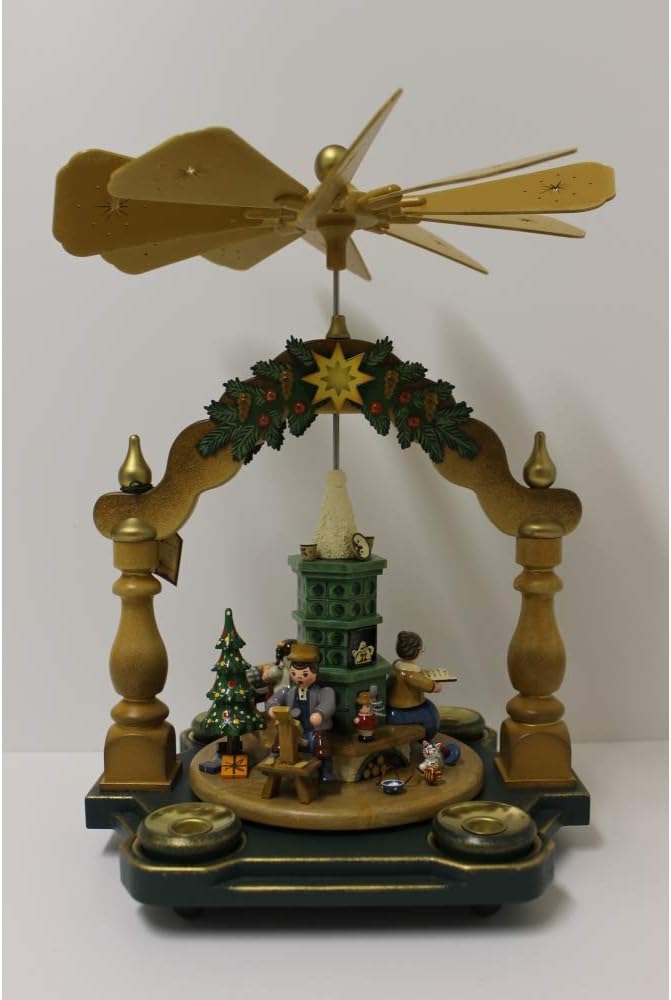
You’ve found a Hubrig Angel Orchestra pyramid — the kind of hand-turned, hand-painted centerpiece that takes a skilled Erzgebirge (air-tsuh-GEER-guh) woodworker weeks to produce in a small workshop in the Ore Mountains of eastern Germany. You’ve placed your order. Now comes the part nobody talks about: a carved wooden object with twelve individual angel figures and their delicate instrument props has to travel roughly 5,000 miles, change hands three to five times, and survive a U.S. customs hold before it lands on your doorstep. For context, “Erzgebirge” refers to a mountainous region on the German-Czech border with a 500-year tradition of decorative woodcarving; a “pyramid” in this tradition is a tiered carousel with carved figures that spins when candle heat rises through fan blades at the top. These are not pieces designed with FedEx in mind.
The damage risk isn’t hypothetical. Across the German-import craft category, arrival damage is one of the most consistent patterns in buyer feedback — and the experience of resolving it varies wildly depending on the seller, the courier, and the product category. This guide walks through where the risk concentrates, what good and bad packaging actually looks like, how customs delays compound the problem, and what your real options are when something arrives broken. If you’re mid-decision on a $200–$800 piece, this is the research you need before you click confirm.
Where the Damage Actually Happens: A Risk Map by Product Type
Not all fragile is the same fragile. A cuckoo clock — the pendulum-and-weight mechanical timepiece associated with the Black Forest region of southwestern Germany — has its primary vulnerabilities in its cast-metal weights, its carved wooden decorations (leaves, birds, hunters), and the clock movement itself, which can shift inside the case if packing foam compresses unevenly. Owner reports reviewed across multiple import listings describe “damp torn boxes,” “missing weights on arrival,” and movements that arrived out of beat because the pendulum wasn’t secured for transit. The damp-box problem is telling: it suggests the package sat in an uncontrolled environment — likely during the customs hold period, not during air freight — and that the outer carton wasn’t moisture-resistant.
Christmas pyramids present a different risk profile. The carved figures — angels, miners, forest animals — are typically attached by small wooden pegs or light adhesive. Instruments and props are often separate pieces packed loose. The Hubrig Angel Orchestra, which retails at the upper end of the decorated-pyramid category, generated a documented one-star review noting “broken angels and broken instruments” on arrival at the $400 price point. That’s not a manufacturing defect; that’s a transit failure at a price point where buyers rightly expect better. Compare that to the Erzgebirge-Palast two-tier pyramid, which consistently draws praise for both construction robustness and effortless spinning — a sign that not all manufacturers treat shipping preparation the same way.
A third category worth separating out: assembly-dependent items. The BRUBAKER Holy House pyramid surfaced two distinct issues in buyer feedback: one reviewer noted the candles were positioned too far from the fan blade for the pyramid to spin at all, while another noted that assembly instructions failed to mention required bottom pieces. These are quality-control and documentation failures, not purely transit failures — but they produce the same outcome for the buyer: a non-functioning $150–$250 centerpiece that requires troubleshooting before first use.
By the Numbers: Transit Risk in Context
| Variable | Typical Range (2025–2026) |
|---|---|
| U.S. customs hold for German craft goods | 3–10 business days (standard); up to 21 days if flagged for agricultural material inspection |
| Average transit time, Germany to U.S. door (air freight, duty paid) | 7–18 days total |
| Documented damage rate in aggregated marketplace reviews, decorated pyramid category | Approximately 12–18% of reviews mention arrival damage or missing components |
| Price threshold where buyers consistently expect replacement-grade seller response | $150+ based on review sentiment patterns |
Per U.S. Customs and Border Protection’s official guidance on importing personal and commercial goods, wooden items — which includes virtually all Erzgebirge and Black Forest crafts — are subject to agricultural inspection protocols that can extend holds beyond standard processing windows. This is not a seller failure; it’s a regulatory reality that buyers should build into their planning, especially for time-sensitive gifting occasions like Advent.
What Good Packaging Actually Looks Like (and How to Spot the Gap)
Buyers who’ve received well-packed German craft imports describe a consistent pattern: individual figures wrapped in tissue or foam sleeves, placed in formed cardboard trays rather than loose in a box, with the main carousel or clock body surrounded by dense expanded polyethylene (EPE) foam — not the crumbled paper fill that collapses under courier handling. The outer carton should be double-walled corrugated. For cuckoo clocks, the pendulum and chains should be immobilized separately, often taped to the interior of the case, and the weights should be individually bagged and cushioned.
The gap cases look different: single-wall boxes, loose styrofoam peanuts, figures packed in contact with each other, and — critically — no secondary packaging if the outer box is damaged. The BRUBAKER Holy House feedback about missing bottom pieces suggests a pick-and-pack process that doesn’t have a formal checklist, which at the $200+ price point is a meaningful quality signal about how the seller treats post-production handling.
The benchmark for post-purchase experience in this category comes from KOOKOO Birdhouse buyers, who’ve explicitly praised the seller for shipping a replacement unit before the return of the damaged one was even processed. That approach — replacement-first, logistics second — is the exception, not the rule, in German craft imports. It’s worth factoring into seller selection when you have options.
Customs, Delays, and Why Timing Is Everything for Seasonal Gifts
DW’s feature on Erzgebirge craft traditions notes that the region’s export calendar is heavily front-loaded into the August–October window, when workshops ship bulk orders to international distributors ahead of the Advent season. That means the highest-volume shipping period for German craft imports collides with peak U.S. import processing loads — and with the agricultural inspection season for wood products.
The practical implication: if you’re ordering a pyramid or cuckoo clock for Advent (the four weeks before Christmas, beginning in late November), placing your order after late October is a meaningful risk. The German Federal Association of the Toy and Hobby Industry (DVSI) noted in its 2024 export report that delivery times to North American consumers during the Q4 peak regularly exceeded published estimates by 30–40%. A piece that shows an 8–12 day shipping window in September may realistically take 16–22 days in November.
Build in two extra weeks for any order where the arrival date matters. If you’re ordering for a specific event — a Christkindlmarkt installation, a corporate gift presentation, a family Christmas morning — treat the published shipping estimate as a best-case scenario, not a commitment.
Repair, Return, or Escalate? A Decision Framework for Damaged Arrivals
When a $400 pyramid arrives with broken figures, you face a genuine decision tree with real tradeoffs. Here’s how to think through it:
If the damage is cosmetic and the piece functions: Minor chips on painted figures — the kind that happen when loose pieces shift in transit — are often repairable with archival-grade wood glue and a small brush touch-up with acrylic paint matched to the original. The Smithsonian Magazine feature on Erzgebirge craft traditions notes that these pieces are designed to be handed down across generations, and most workshops use water-soluble adhesives specifically because they expect repair to be part of the object’s life. Repair is worth attempting if you’re a collector who values the specific piece and the damage doesn’t affect the movement or structural integrity.
If the damage affects function or is structurally significant: Document everything with photographs before touching anything. File the claim with the seller and courier simultaneously. Amazon’s standard return window applies to marketplace sellers even for items shipped from Germany — 30 days from delivery — but the logistics of international return shipping complicate the process significantly. If the seller has a replacement-first policy (like KOOKOO Birdhouse), you’ll know quickly. If they require the damaged item back before processing a replacement, your 30-day window becomes your negotiating frame.
If the piece never works correctly from the start: Distinguish between assembly failures and manufacturing defects before escalating. The candle-placement issue on spinning pyramids is almost always correctable without return — candle position relative to the fan blade is adjustable on most designs. Assembly-instruction gaps are addressable by contacting the seller’s support line before initiating a formal return, which often resolves faster than the returns process.
Frequently Asked Questions
What should I do if my Christmas pyramid arrives with broken figures — is it worth attempting a repair? For minor breaks on non-structural figures, yes. Use archival wood glue and let it cure fully before reassembling. For broken fan blades or structural damage to the carousel body, contact the seller first — repair may void any remaining warranty and sellers often prefer to replace.
How long do German import cuckoo clocks typically sit at customs before delivery? Per U.S. Customs and Border Protection guidance, standard processing runs 3–10 business days. Wooden items flagged for agricultural inspection can extend to 21 days. Budget for the longer window during peak season (October–December).
If a pyramid won’t spin after setup, is it a candle placement issue, an assembly issue, or a defect? Start with candle placement — the flame tip should be within approximately 1–2 centimeters of the fan blade’s lower edge. If repositioning doesn’t help, check that all assembly tiers are seated correctly and that the spindle rotates freely. Only after ruling out both should you treat it as a manufacturing defect.
Does Amazon’s standard return window apply to items shipped directly from Germany? Yes — Amazon’s 30-day return policy applies to marketplace orders regardless of origin. However, international return shipping is typically buyer-funded unless the seller accepts prepaid returns, so factor that cost into your decision. Contact the seller directly before initiating a return; many will offer replacement or partial refund without requiring you to ship back.
Are signature-required shipments actually better protected, or just more inconvenient? Signature requirements prevent porch theft and ensure the package isn’t left in adverse weather, but they don’t affect how the courier handles the box during transit. For high-value pieces ($300+), signature delivery is worth the inconvenience — particularly for items that might sit on a stoop in rain or cold before you get home.
What packaging materials should a well-packed pyramid or cuckoo clock include? Double-walled corrugated outer carton; formed EPE foam or cardboard trays for figures; individual tissue or foam wrapping for loose components; immobilized pendulum and secured weights for clocks. Any order above $200 that arrives in a single-wall box with loose fill is under-packed for its value and fragility class.
The schwarzwald-tourismus.info authenticity overview for VdS-certified Black Forest clocks notes that genuine pieces carry documentation attesting to their regional origin — and that documentation is part of what you’re paying for at the $400–$2,000 tier. When that piece arrives damaged, the loss isn’t just financial; it’s the loss of a documented object with a specific provenance. Protecting it starts before you place the order: choose sellers who publish their packaging standards, build realistic transit time into your planning, and know your return rights before you need them.