A beer stein — at its most basic — is a handled drinking vessel, typically holding one liter (roughly 34 ounces), often with a hinged lid. The lid isn’t decorative trivia: according to Atlas Obscura’s piece on the history of lidded steins, the practice of covering drinks traces to post-plague sanitation customs in 14th-century Germany, when open containers were associated with contamination risk. Today the lid signals tradition more than hygiene, but it still matters to buyers. What actually shapes your buying decision — whether you’re sourcing for a personal collection, an Oktoberfest party of forty, or a corporate hospitality gift — is the material the stein is made from: glass, ceramic, or stoneware. That single choice drives weight, feel, thermal performance, cleaning behavior, and the signal a stein sends when you hand it to someone. This guide draws on aggregated owner reviews, published manufacturer specs, and editorial research from named sources to help you make that call clearly, with tradeoffs named and the logic shown.
The Material Decision Is Really Three Separate Decisions at Once
Before you look at brand names or price tiers, it helps to understand what each material is optimized for. These aren’t purely aesthetic choices — the material governs durability, the drinking experience, and what the stein communicates as a gift or prize.
Glass Steins: Built for the Occasion
1
$24.90
In stock on Amazon
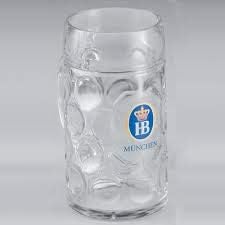
Check price on AmazonGlass steins — the classic dimpled Masskrug style associated with Hofbräuhaus — are purpose-built for the drinking experience. Thick borosilicate walls give you satisfying heft and the ability to clink hard without flinching. Owners of HB-branded glass steins consistently highlight the volume accuracy and what several reviewers describe as “the joy of a hard celebratory clink.” One reviewer specifically praised the format for serving from an Oktoberfest mini-keg at a home party — a use case that points to the core strength of glass: functional celebration ware meant to be used, not displayed. Glass is also transparent, which lets the beer speak for itself.
The tradeoff is clear: glass chips and shatters. Drop a ceramic stein on a concrete patio and you might lose a rim chip. Drop a glass stein and you’re sweeping. For events where steins will travel through crowds or end up in the hands of people who’ve already had a few, that’s a real operational consideration worth planning around. Glass is the right choice for bar service, home parties, and any occasion where the experience of drinking from a proper liter stein is the point — and where breakage risk is manageable.
1
$24.90
In stock on Amazon
Check price on AmazonCeramic Steins: The Gift-Category Sweet Spot
HAUCOZE
$49.98
In stock on Amazon
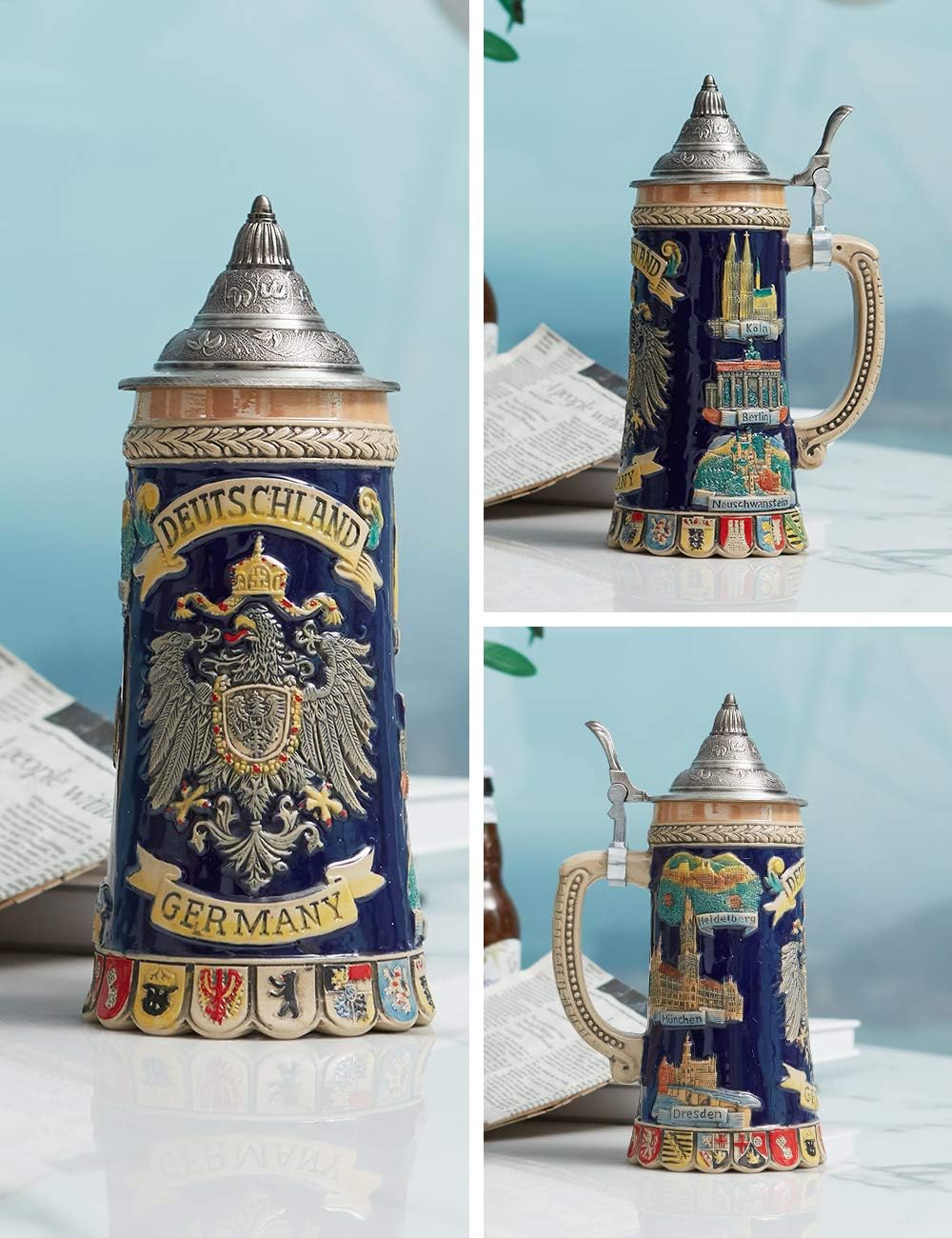
Check price on AmazonCeramic steins occupy the middle ground between the pure utility of glass and the heirloom density of stoneware. They’re typically lighter than stoneware, more decorative than glass, and they often feature the painted or relief-molded scenes — Bavarian hunting imagery, village vistas, the familiar Munich skyline — that make them compelling as gifts. The HAUCOZE line of pewter-lidded ceramic steins is a strong representative of this category. Reviewers consistently describe them as “beautiful” and “gift-worthy,” and they land well in the $30–$80 price window that suits mid-range gift-giving.
That said, an observant reviewer flagged something worth internalizing: the relief detail on HAUCOZE pieces is “bubbly and not hand carved — for sure made with a mold.” For a $45 gift stein, molded production is perfectly appropriate and expected; for a collector, it’s disqualifying. Molded relief is not hand-carving, and buyers who care about craft provenance should register that distinction clearly before purchasing.
A second detail from HAUCOZE reviews: some buyers noted a strange white powder residue requiring a thorough wash before first use. This is almost certainly a kiln wash or mold-release compound — not a safety concern, but worth knowing so you don’t hand a new stein directly to a guest. A 10-minute soak in warm water with a small amount of white vinegar, followed by a rinse, handles it cleanly.
The Spruce’s guide to beer glassware notes that personalized vessels are among the highest-return gift categories in the drinkware market — but the publication advises buying from sellers who provide actual engraving samples rather than digital mockups, because preview images consistently flatter the finished product. That guidance applies broadly to any decorated ceramic stein: request photos of the physical piece, not just the rendering.
HAUCOZE
$49.98
In stock on Amazon
Check price on AmazonStoneware Steins: Daily Use and Serious Durability

0.55L
$67.89
In stock on Amazon
Check price on AmazonStoneware is the serious end of functional ware. As GermanCulture.com.ua’s overview of traditional German steins explains, authentic German drinking vessels were historically fired at high temperatures — a process that produces a dense, low-porosity clay body that keeps liquids cold longer and resists bacterial growth more effectively than standard earthenware ceramics. The result is a vessel that feels substantial in the hand, performs thermally, and tolerates real-world daily use without the fragility of glass.
The Helko Werk stoneware stein earns consistent owner praise as a daily-use vessel. Reviewers report using it interchangeably for beer and cold drinks, which is a practical testament to stoneware’s neutral flavor profile — no material off-notes bleed into the beverage the way they can with cheaper ceramics or certain metal vessels.
The Herbst and Winter seasonal stoneware steins occupy a specific niche worth calling out: owners repeatedly purchase them as event prizes — for trivia nights, holiday parties, and charity raffles. That’s a distinct purchase segment with its own logic. You’re buying something visually appealing enough to be a desirable prize but priced low enough to order in volume. Stoneware in this category threads that needle well, and the durability means prize recipients aren’t handling something fragile.
DW’s coverage of Bavarian traditions makes a useful distinction here: stoneware drinking vessels are part of an unbroken utilitarian tradition in Bavaria, distinct from the decorative collectible stein market. That distinction matters when you’re deciding how much to spend and what you’re actually buying.
0.55L
$67.89
In stock on Amazon
Check price on AmazonBy the Numbers: Material Comparison at a Glance
| Material | Typical Weight (empty) | Thermal Retention | Dishwasher Safe | Best Use Case |
|---|---|---|---|---|
| Glass (thick-walled) | 2.0–2.5 lbs | Low | Usually yes | Active celebration, bar service |
| Ceramic (pewter-lid) | 1.5–2.0 lbs | Moderate | Check lid separately | Gifting, display, casual use |
| Stoneware | 2.5–3.5 lbs | High | Usually yes | Daily use, event prizes, collectors |
Weights based on published manufacturer specs and aggregated owner descriptions. Thermal ratings are relative, not lab-measured.
The Personalization Question: What Review Patterns Actually Tell You
Personalized steins — laser-engraved with a name, date, or monogram — are a booming gift segment. The HomeWetBar personalized stein is one of the most-reviewed examples in this category, and its review pattern is polarized in an instructive way: one buyer calls the engraving “subtle and classy,” reading the light touch as a deliberate design choice. Another reports the engraving is essentially invisible under normal light and that the pewter lid showed corrosion after routine use.
That split isn’t a contradiction — it’s a production signal. Laser engraving depth varies by production run, and high-volume personalization operations struggle to maintain consistent depth settings across individual orders. The corrosion issue on the lid is a separate problem: pewter alloys vary, and cheaper alloys oxidize faster, especially with repeated dishwasher cycling. If you’re ordering personalized steins in quantity for a corporate event or wedding, ask the seller directly about lid alloy composition and request a physical sample before committing to a full run. The $20–$40 sample investment is cheap insurance against a $500+ order disappointment.
Smithsonian Magazine’s historical overview of European metalwork notes that quality pewter is traditionally 92% or more tin with antimony and copper as hardening agents — a composition that resists oxidation well. Cheap alloys substitute bismuth or lead-free base metals that look similar but degrade faster. If a listing doesn’t specify alloy composition, assume the lower-quality range and plan to handwash.
How to Match Stein Type to Occasion
The practical decision frame that emerges from aggregated owner behavior:
Oktoberfest parties and home bar service: Glass, unambiguously. The dimpled liter stein is the contextually correct vessel. Owners are clear that the thick glass, the transparency, and the clink factor all contribute to the experience in ways ceramic and stoneware don’t replicate. If you’re running mini-keg service for a group, glass is the functional choice.
Gift-giving in the $30–$80 range: Pewter-lidded ceramic. The visual appeal is high, the price fits the occasion, and the decorative relief tells a story even if it’s molded rather than hand-carved. Wash before first use; check lid dishwasher compatibility before assuming.
Event prizes and bulk purchases: Seasonal stoneware steins offer the best combination of durability, visual appeal, and price-per-unit. Owner behavior in reviews confirms this is already how people are using them — they’re purchasing in small multiples specifically for trivia nights and holiday events.
Daily-use drinker: The Helko Werk stoneware stein earns its reputation here. Owners use it for everything, and stoneware’s thermal properties and neutral material make it genuinely versatile across beverages.
Serious collector: None of the mass-market production options above apply. As Atlas Obscura notes in its history of lidded steins, the most sought-after 19th-century Villeroy & Boch Mettlach pieces now trade at auction for hundreds to thousands of dollars. You would not pour beer into one. Collectible steins — Mettlach editions, signed Marzi & Remy pieces, antique pewter-lidded examples with documented provenance — are a separate research category entirely. A $45 production stein is not an investment vehicle, and conflating the two categories is the most common buyer mistake in this segment.
Frequently Asked Questions
What is the actual liquid capacity of a 1-liter dimpled glass stein? The nominal “1-liter” capacity refers to total internal volume, but most German steins are filled to a Eichstrich — a calibration line — leaving roughly 10–15% headroom for foam. In practice, you’re pouring about 850–900ml of liquid. Owner descriptions of HB glass steins confirm this: the stein holds a full liter to the brim but is traditionally served to the fill line.
Are pewter lids on mid-range steins safe for regular use? Modern pewter is lead-free — a standard enforced in the EU since the 1990s. The concern with mid-range lids isn’t toxicity in new products; it’s corrosion and finish degradation over time, especially with repeated dishwasher cycling. Quality pewter runs 92%+ tin with antimony and copper, per the composition standards Smithsonian Magazine references in its European metalwork coverage. If the listing doesn’t specify alloy, handwash as a default.
How do I clean a new ceramic stein before first use? Wash thoroughly with warm soapy water and rinse well. The white powder residue flagged in HAUCOZE reviews is almost certainly a kiln wash or mold-release compound — harmless but unpleasant. A 10-minute soak in warm water with a small amount of white vinegar, followed by a rinse, is sufficient. Don’t skip this step regardless of how clean the stein looks out of the box.
Is the relief detail on production ceramic steins hand-carved or molded? Molded, at the $30–$80 price point. A HAUCOZE reviewer put it plainly: the detail is “bubbly and not hand carved — for sure made with a mold.” This is standard for production ceramics and not a defect — it’s a manufacturing method that keeps costs accessible. Genuine hand-carved steins are produced in small ateliers, typically cost $150 or more, and are generally sold as collectibles rather than drinkware.
Can personalized engraved steins go in the dishwasher? Generally no, and this applies especially to steins with pewter lids. The engraving itself may survive dishwasher cycles on glass or stoneware bodies, but the lid hardware — hinges, thumb-lifts, and the pewter itself — degrades significantly with heat and detergent exposure. Handwashing is the safe default for any lidded stein with a metal component.
The decision rule: If you’re buying for active use and celebration, choose glass for the experience and stoneware for the durability. If you’re buying to give, pewter-lidded ceramic in the $40–$80 range hits the visual sweet spot at an appropriate price. If you’re buying for a serious collector, none of the mass-market production steins apply — and that’s a different research project entirely, starting with auction records rather than retail listings.