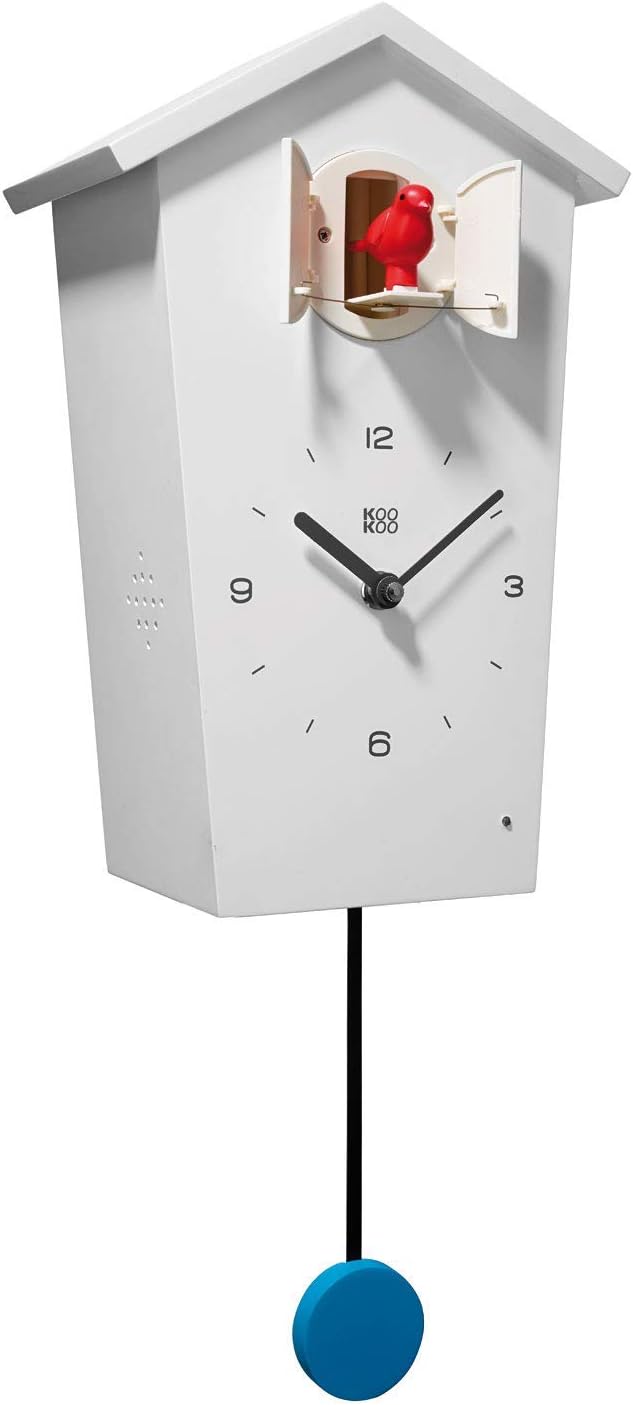
The cuckoo clock — a mechanical timekeeping device with a small carved bird that pops out and calls on the hour — has been made in Germany’s Black Forest region for roughly 300 years. The traditional version looks exactly like what you’d expect: a carved wooden chalet or hunting lodge, draped in carved leaves and deer antlers, with pinecone-shaped weights hanging from chains. That design is a genuine craft tradition, and many collectors love it. But for buyers who want the mechanical heritage and handmade quality without the rustic alpine aesthetic, a newer category has been growing steadily: modern and design-forward cuckoo clocks that strip the ornamentation down to clean geometry while keeping the same certified, hand-assembled German movements inside. This guide is for buyers who already know what a quartz movement is, have a sense of what “VdS certified” means, and are now trying to figure out whether the stripped-down Bauhaus-adjacent designs are worth the price premium — and which specific tradeoffs you’re accepting when you choose form over forest.
What “Modern Design” Actually Means in This Category
The phrase “modern cuckoo clock” covers a wide range of things, and it helps to separate them before you commit to a purchase.
At one end, you have design-studio interpretations: clocks produced by German studios — most notably kookoo (stylized lowercase), Rombach & Haas, and a handful of smaller Black Forest workshops — that retain hand-assembled mechanical movements but replace the carved chalet housing with flat, geometric, or architecturally minimal cases. These are still made in Germany. Some carry the VdS Schwarzwald certification (the official quality seal from the Verband der Schwarzwälder Uhrmacher, the Black Forest clockmakers’ association), and some do not — because the certification schema was written around traditional carved-case standards, and a minimal lacquered plywood case may not qualify even if the movement inside is identical to a VdS-certified clock.
At the other end, you have aesthetic imitations: clocks that use the word “modern” and a simplified silhouette but run on battery-powered quartz movements with a digital cuckoo sound chip. These are legitimate products for certain buyers, but they are not in the same category as a hand-assembled mechanical clock, and the resale and collector value reflects that gap.
The decision frame here is straightforward: if mechanical movement + German origin is a hard requirement, you need to verify both independently of the case design. A beautiful minimal case with a quartz movement is a decorative object. A beautiful minimal case with a certified mechanical movement is a cuckoo clock that happens to look contemporary.
Per Deutsche Welle’s feature on Black Forest craft traditions, the movement — not the case — is the irreducible core of what makes a cuckoo clock a cuckoo clock in the traditional sense. That framing matters when you’re allocating $300–$1,200 for a piece and evaluating whether the modern premium is justified.
The Tradeoffs: What You Gain and What You Give Up
Here’s where practitioners tend to underweight the cost side of the modern-design decision.
What you gain:
-
Visual versatility. A flat, geometric clock in matte black or natural birch plywood works in a mid-century modern living room, a Scandinavian-influenced home office, or a minimalist kitchen without fighting the other design choices in the room. The Spruce’s decorating guidance on cuckoo clocks in contemporary interiors specifically flags this as the primary driver for design-forward buyers: the clock becomes a conversation piece rather than a thematic commitment.
-
Lower maintenance perception. Carved traditional cases — especially the hand-painted Chalet style with multiple moving figures — require careful handling and occasional restoration of painted elements. A minimal case in lacquered wood or powder-coated metal has fewer surface details to damage.
-
Gift-ability across a wider audience. If you’re a corporate buyer or interior designer sourcing for a hospitality client, a sleek design-forward clock integrates more easily into a curated installation than a traditional Schwarzwald Haus model.
What you give up:
-
Carving as craft signal. Part of what drives the secondary-market value of high-end traditional clocks — a Rombach & Haas hand-carved eight-day movement clock, for example, or a signed Hekas piece — is the visible labor embedded in the carving. Auction records tracked by specialist dealers show that carved, signed, documented pieces from named Black Forest workshops consistently outperform their non-carved equivalents at resale. A minimalist case, however beautiful, strips out that carving signal.
-
VdS certification clarity. As noted above, the certification framework was built around carved traditional cases. The Schwarzwald Tourismus GmbH’s published overview of Black Forest craft designations confirms that the VdS seal requires both movement and case to meet the association’s standards. Some modern-design studios have navigated this by documenting their movements separately; others simply don’t pursue VdS certification. This matters if you’re buying for a collector audience that uses the seal as a shorthand for authenticity.
-
Resale liquidity in the collector market. The serious collector market — the audience researching Rombach & Haas, Hekas, and signed limited editions — is largely oriented around traditional forms. A beautiful kookoo studio piece at $400 may be harder to move on the secondary market than a comparably priced traditional carved clock from a named Black Forest atelier, simply because the buyer pool is narrower.
By the Numbers
| Price Tier | Representative Designs | Typical Movement | VdS Eligible? |
|---|---|---|---|
| $150–$350 | Design-studio minimal, birch or MDF case | Quartz (most) or basic 1-day mechanical | Rarely |
| $350–$700 | kookoo, Rombach & Haas modern line | 1-day mechanical, hand-assembled | Sometimes (movement only) |
| $700–$1,400 | Rombach & Haas 8-day minimal, Hekas commissioned | 8-day mechanical, German-made | Case-dependent |
How to Evaluate a Specific Modern Cuckoo Clock Before Buying
The evaluation checklist for a modern design piece is slightly different from the traditional-clock checklist, and buyers who carry over the traditional checklist without adjusting tend to either over-pay for a quartz piece or under-appreciate a genuine mechanical one.
Step 1: Confirm movement type and origin. The listing or product description should explicitly state whether the movement is quartz (battery-powered) or mechanical (weight- or spring-driven). If it says “battery operated” anywhere, it is quartz. If it says “8-day movement” or “1-day movement” with chains and weights, it is mechanical. The Atlas Obscura piece on the German Clock Road notes that the weight-and-chain drive system is the functional signature of authentic Black Forest mechanical work — this remains true regardless of case design.
Step 2: Ask about movement provenance separately from case origin. Some modern-design studios source cases from non-German manufacturers while using genuine Black Forest movements. This is not inherently fraudulent, but it’s a different product than one made entirely in Germany, and the price should reflect that. Ask for the movement manufacturer’s name — common legitimate suppliers include Hubert Herr and Regula, both longstanding German movement makers.
Step 3: Check the certification status honestly. If VdS certification matters to your buyer or end use, verify it directly rather than relying on marketing language. The Verband der Schwarzwälder Uhrmacher publishes certification criteria; Schwarzwald Tourismus GmbH’s craft overview summarizes the key requirements. A clock described as “in the Black Forest tradition” is not the same as a VdS-certified clock.
Step 4: Evaluate the case material as a long-term investment. Solid linden wood (the traditional carving material) ages differently than MDF, birch plywood, or laser-cut materials used in many modern designs. For pieces you expect to hold value or pass on, solid wood cases age more gracefully and are more repairable. The Smithsonian Magazine’s history of the cuckoo clock notes that many 19th-century clocks survive in collectible condition precisely because linden wood is stable and repairable over generations — an argument that’s harder to make for engineered wood.
Step 5: Price-test against the traditional equivalent. If a modern minimal design commands a $200–$400 premium over a comparable traditional piece with the same movement, ask what that premium is buying. If the answer is “case design and aesthetic versatility,” that may be worth it to your buyer. If the answer is unclear, it may be a margin extraction on the “modern” label.
Which Buyers Should Lean Modern — and Which Should Stay Traditional
This is the decision rule the headline promises, so here it is plainly:
If X, then Y:
-
If your buyer is a first-generation collector building toward heirloom investment value, stay with certified traditional pieces from named ateliers. The secondary market data supports traditional carved, documented, signed pieces as the more liquid and appreciating asset class. A Rombach & Haas 8-day carved Chalet clock with full documentation is a different financial object than a beautiful minimal clock from the same brand’s design line.
-
If your buyer is an interior designer or hospitality client sourcing for visual integration, modern design is a legitimate and often superior choice. The Spruce’s guidance on contemporary cuckoo clock styling confirms that minimal and geometric designs solve the “how do I use this in a non-rustic room” problem more cleanly than trying to style around a traditional carved case.
-
If you’re buying as a mid-range gift ($200–$500) for a Germanophile who appreciates craft but isn’t a strict collector, a modern design with a genuine mechanical movement is genuinely compelling. It delivers the mechanical interest — the weights, the chains, the hand-assembled movement — without requiring the recipient to commit to a thematic decorating choice.
-
If certification and provenance documentation matter to the end buyer, modern designs require more due diligence, not less. Budget time to verify movement origin and confirm VdS status before committing.
The Black Forest has been navigating the tension between traditional form and contemporary taste for at least four decades — DW’s reporting on the region’s craft industry notes that design experimentation accelerated in the 1980s and has been a deliberate strategy for several major workshops since then. The modern cuckoo clock is not a compromise of the tradition; it’s an extension of it. But it’s an extension that rewards careful evaluation, and the buyers who do that evaluation well are the ones who end up with pieces they’re genuinely proud of — regardless of which direction they choose.