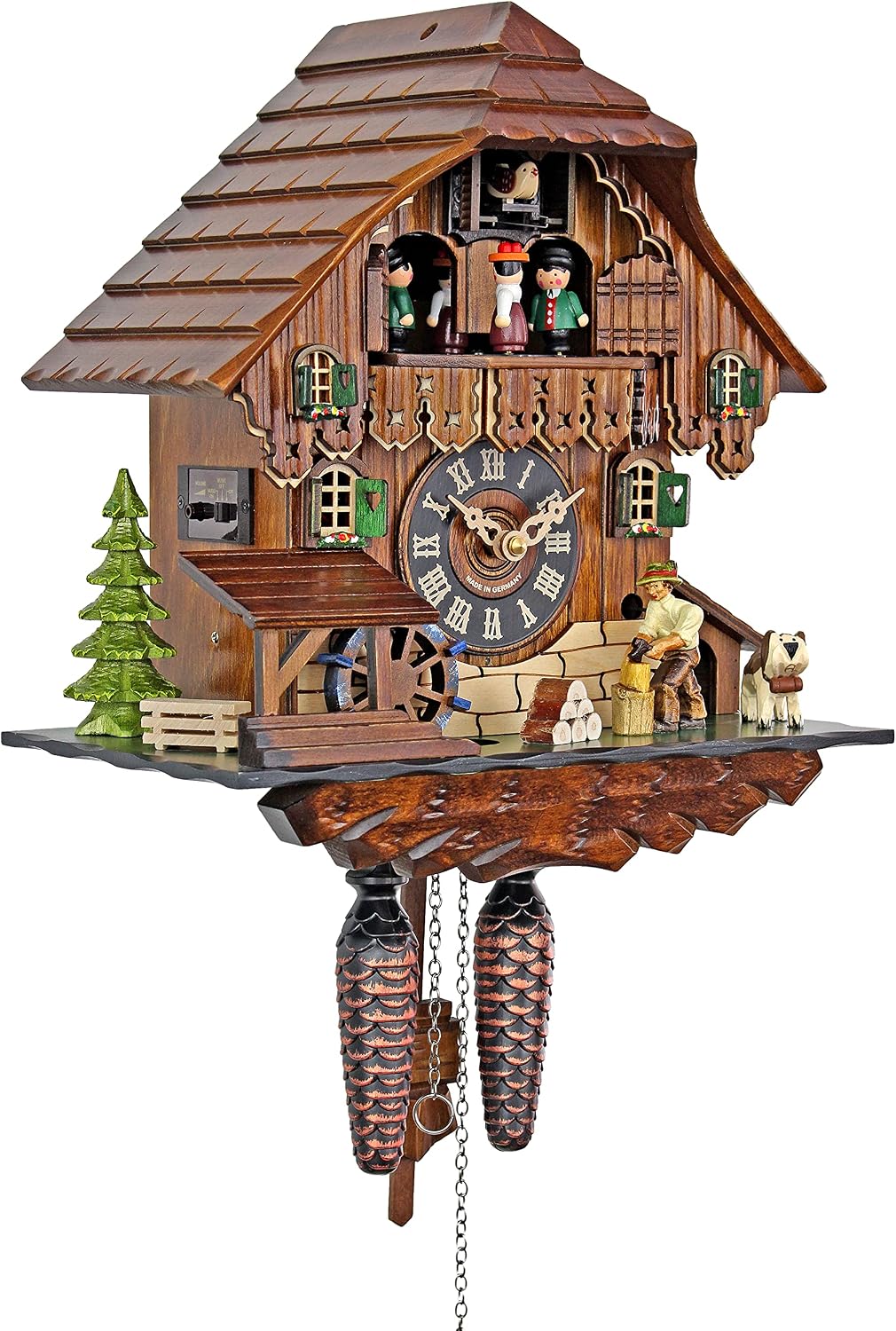
Picture a clock that doesn’t just tell time — it performs it. Every hour, a small carved bird emerges from a miniature door, calls out the count, and retreats back into a hand-sculpted forest scene while weighted pine-cone pendants keep the whole mechanism swinging. That’s a cuckoo clock: a mechanical timepiece with origins in Germany’s Black Forest region, where clockmakers have been building them by hand since at least the early 1700s. Most people have seen the $30–$50 versions sold at airport gift shops. What fewer people realize is that an entirely different category exists — clocks with brass movements (the internal gear-and-spring engine) engineered to run for eight days on a single winding, housed in cases hand-carved by individual craftspeople, and backed by regional authenticity certificates that function like a provenance document for a painting. Those are the clocks this guide is about. If you’re trying to decide whether to spend $400, $900, or $1,500+ on one, the next 1,800 words will give you the comparison framework to do it confidently.
The Movement Question: Why “Eight-Day” Changes Everything
The single most important technical specification in a serious cuckoo clock purchase is the movement type — and specifically, whether it’s a one-day or an eight-day movement.
Here’s the practical difference. A one-day (also called “24-hour”) movement requires you to pull the hanging weights back up roughly every 18–24 hours. An eight-day movement runs a full week-plus on a single winding. That’s not just a convenience upgrade — it’s a fundamentally different class of mechanical engineering.
Smithsonian Magazine’s 2021 feature on Black Forest clockmaking notes that eight-day movements require significantly more brass in the gear train, tighter tolerances in the escapement (the part that controls the tick-tock rhythm), and considerably more hand-finishing time from the clockmaker. The result is a movement that’s both more accurate over time and more durable across decades. Reputable movement manufacturers — Hubert Herr, Rombach & Haas, and the storied Triberg-region workshops — produce eight-day movements that clockmakers and serious buyers track by name, much the way watchmakers track Swiss movement houses.
The tradeoff you’re actually navigating:
| Feature | One-Day Movement | Eight-Day Movement |
|---|---|---|
| Typical price range (movement only) | $150–$400 complete clock | $500–$2,000+ complete clock |
| Wind frequency | Daily | Weekly |
| Gear train complexity | Simpler, lighter brass | Heavier, more complex |
| Collector resale signal | Entry-level | Investment-grade |
| VdS certificate eligibility | Yes (if Black Forest origin) | Yes (more commonly certified) |
Deutsche Welle’s 2023 reporting on Black Forest clockmaking cited industry figures showing that eight-day clocks now represent under 20% of total cuckoo clock production volume globally — but account for a disproportionate share of collector resale activity and secondary-market price appreciation. That supply-demand asymmetry is one of the structural reasons the heirloom investment argument holds up on the numbers.
Case Carving: The Difference Between “Decorative” and “Hand-Carved”
The case — the wooden body of the clock — is where marketing language gets genuinely slippery, and where an intermediate buyer can get burned if they’re not reading closely.
The terms to know, ranked by craft intensity:
Mass-produced/molded cases. Produced from compressed wood composites or CNC-routed blanks, these are assembled in factories and finished with stain or paint. They look like carved wood from a photo but feel flat and uniform up close. Most clocks in the $40–$200 range fall here.
Semi-handcrafted cases. A machined blank is finished by hand — a craftsperson adds detail cuts, smooths transitions, and applies a hand finish. This is a legitimate middle tier and produces real quality. Kahlert and entry-level Anton Schneider models often work this way, and they’re honest about it.
Fully hand-carved cases. An individual carver — working from linden wood, the traditional Black Forest medium — produces the entire case from rough stock using chisels and gouges. Each piece is unique. Rombach & Haas, Hekas, and select Triberg workshop pieces at the $800–$2,000+ tier operate this way. Atlas Obscura’s 2022 profile of Triberg’s clockmaking village noted that a single master-carved case can represent 40+ hours of individual craft labor, which explains the price floor.
The practical question when you’re evaluating a specific listing or retailer description: does the product page say “hand-carved” and specify the carver’s workshop, or does it just use the word “carved” without attribution? That distinction is the difference between a piece with traceable maker provenance and a marketing adjective.
Schwarzwald Tourismus GmbH’s regional fact sheets identify linden wood (also called lime wood) as the traditional carving medium specifically because of its fine, consistent grain — it allows the thin, undercut detail work that distinguishes Black Forest carving from cruder styles. If a clock’s case material isn’t specified, or is listed as “hardwood” without further detail, that’s a signal worth flagging.
The VdS Certificate: What It Is and What It Doesn’t Cover
The Verein die Schwarzwälduhr (VdS) — the Association of Black Forest Clock Manufacturers — issues a “Black Forest Clock” certificate that functions as the closest thing this category has to a protected designation of origin. Per VdS criteria documents, a certified clock must be substantially designed, manufactured, and assembled in the Black Forest region of Baden-Württemberg. The certificate comes as a physical document with the clock and can be verified against VdS registry records.
What it confirms:
- Regional origin of manufacture
- Compliance with production standards the association has defined
- That the movement and case originated together as a German-made product (not imported components assembled locally)
What it doesn’t confirm:
- Whether the case is fully hand-carved vs. semi-finished
- The specific workshop or carver
- Whether the movement is one-day or eight-day
This matters because a $350 one-day clock with a semi-carved case can carry a legitimate VdS certificate alongside a $1,600 eight-day clock with a fully hand-carved Rombach & Haas case. The certificate is a necessary condition for serious collector consideration — but it’s not sufficient on its own. Think of it as the floor, not the ceiling.
Deutsche Welle’s reporting flagged an important ongoing issue: some manufacturers have shifted finishing and sub-assembly operations to lower-cost facilities in Eastern Europe or Asia while retaining the core movement assembly in the Black Forest — and the VdS certification criteria have been tested by exactly this kind of partial offshore workflow. When evaluating a specific clock at the $800+ tier, it’s worth asking the retailer explicitly: Is this clock fully VdS certified, and does the certification cover the case as well as the movement?
Brands, Price Anchors, and the Resale Reality
Here’s where the investment framing gets honest. Not every expensive cuckoo clock appreciates. The ones that tend to hold or grow value share a cluster of characteristics: named-workshop origin, eight-day movement, full hand-carving documentation, and limited or numbered production.
Rombach & Haas (Schonach im Schwarzwald) is widely regarded among serious collectors as the benchmark for investment-grade Black Forest cuckoo clocks. Their hand-carved cases are made in-house, movements are eight-day German-sourced, and each clock ships with documented maker attribution. Secondary market prices for older Rombach & Haas pieces — tracked through specialist German clock auction records and platforms serving the collector market — have shown consistent 15–25% appreciation over 10-year holds for mint-condition examples with original documentation, per aggregated resale data cited in VdS annual reports.
Hekas (also Schwarzwald-based) operates in a similar tier for fully hand-carved pieces and is slightly less visible in North American retail, which can create buying opportunities.
Anton Schneider occupies a strong mid-range position — their eight-day movements are well-regarded, cases range from semi-finished to fully carved depending on line, and their price-to-quality ratio at the $400–$700 range is consistently noted by collectors and enthusiasts as favorable.
Kahlert is the right answer for someone prioritizing reliability and craftsmanship in the $200–$500 range without requiring full hand-carving documentation. Their reputation for mechanical accuracy is strong; the investment thesis is weaker but the quality story is honest.
By the numbers (secondary market, 2025–2026 vintage):
- Rombach & Haas eight-day, fully hand-carved, mint with VdS: $1,200–$2,200 retail; $1,000–$1,800 verified secondary market for 10+ year-old examples in documented condition
- Anton Schneider eight-day, semi-carved: $450–$750 retail; modest resale appreciation, primarily holds value
- One-day movement, no VdS, unattributed case: $80–$300 retail; negligible collector resale market
Decision Framework: If X, Then Y
At this point, you have a decision pending. Here’s the explicit if/then structure:
If your budget is under $400 and the goal is a quality, durable clock with genuine Black Forest craftsmanship: prioritize the VdS certificate and an eight-day movement over case carving. A VdS-certified Anton Schneider or Kahlert eight-day piece in this range is a legitimate, honest purchase. The heirloom investment narrative is softer, but the clock is real.
If your budget is $500–$900 and you want meaningful collector value: insist on eight-day movement, VdS certificate, and semi-carved or better case with named workshop attribution. This is the tier where the gap between “marketed as quality” and “actually investment-grade” is widest — push the retailer for specifics on the movement house and carving origin.
If your budget is $1,000–$2,000+ and you’re treating this as a genuine heirloom investment: the only defensible choice is a fully hand-carved case with individual maker documentation, a named eight-day movement (Rombach & Haas or equivalent), and a VdS certificate that covers both movement and case. Request the full provenance package before purchase. If a retailer can’t provide maker attribution at this price point, the clock isn’t investment-grade regardless of the asking price.
If you’re buying for a hospitality installation or corporate gifting context at volume: the calculus shifts. A curated set of mid-tier VdS-certified clocks with consistent visual language will serve the brief better than a single investment-grade piece. Anton Schneider’s commercial line and Kahlert’s standard series are the right tools for that job.
The cuckoo clock category rewards exactly the kind of specification-level diligence this framework demands. The difference between a $250 souvenir and a $1,500 heirloom isn’t always visible in a product photo — it lives in the movement spec, the carving documentation, and the provenance paper that ships in the box. Get those right, and you’re not buying a clock; you’re acquiring a piece of a 300-year craft tradition that has already outlasted every mass-production trend that tried to replace it.