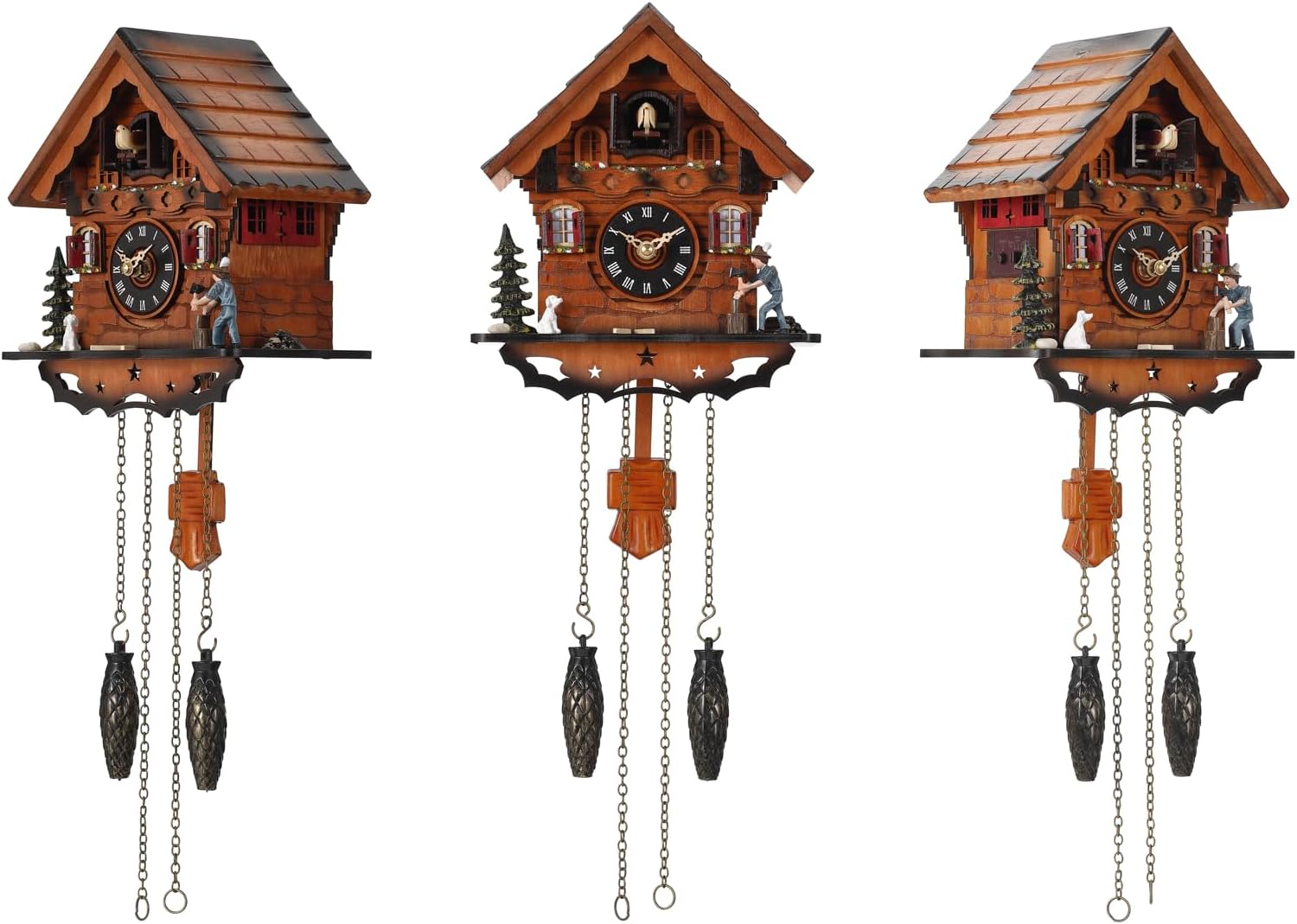
A cuckoo clock is exactly what it sounds like: a wall clock, typically carved from wood in a chalet or hunting-lodge style, from which a small wooden bird emerges on the hour and calls out “cuckoo” a number of times equal to the hour. The craft originates in the Black Forest region of southwestern Germany — a mountainous area roughly the size of Connecticut — where clockmakers have been producing them since at least the early 1700s, according to the German Clock Museum in Furtwangen. The movement inside is what really separates the categories: traditional mechanical clocks run on hanging brass weights and require winding every one or eight days, while quartz models use a battery-powered electronic mechanism instead. Quartz clocks are easier to live with — no winding, no weight adjustment, more consistent timekeeping — and they dominate the under-$200 price tier. If you’re shopping in that range and trying to figure out which styles are worth putting on a wall versus which ones will feel like a novelty trinket inside of six months, this guide is built for that decision.
| EDITOR'S PICKKintrot Cuckoo Clock Pendulum Q… | Mid-tierKintrot Cuckoo Clock | Budget pickKintrot Cuckoo Clock Traditiona… | |
|---|---|---|---|
| Melodies | — | 12 | — |
| Night sensor | — | ✓ | — |
| Singing bird | — | ✓ | — |
| Pendulum type | Pendulum | Maple leaf | Pendulum |
| Material | — | Wood | Wood |
| Price | $185.99 | $100.99 | $95.99 |
| See on Amazon → | See on Amazon → | See on Amazon → |
What You’re Actually Buying in the $80–$200 Quartz Range
Let’s be honest about the category first. Below roughly $80 (manufacturer’s suggested retail), almost everything in the quartz cuckoo clock market is mass-produced with minimal hand-finishing and generic plastic or resin components dressed up as woodcarving. That’s not necessarily a disqualifier for a gift or seasonal decoration, but it’s the wrong tool for someone who wants something with staying power on the wall.
The $80–$200 quartz tier is genuinely more interesting. Here’s where you start finding pieces that carry the VdS label — that’s the Verein die Schwarzwälder Uhrenindustrie, the trade association that certifies authentic Black Forest clock origin. VdS documentation confirms the clock’s movement was produced in the Black Forest region, which has real implications for resale and replacement parts availability. According to VdS program documentation, a certified clock must use a movement manufactured in the Black Forest and be assembled there; the label is applied directly to the clockface or movement housing.
The German Culture overview at germanculture.com.ua notes that the distinction between “made in Germany” and “Black Forest certified” matters more than many buyers realize — the former is a country-of-origin mark, the latter is a regional craft designation with actual production criteria attached. In the quartz mid-range, brands like Kahlert, Anton Schneider, and Hubert Herr commonly hold VdS certification on their lower-production-cost quartz lines. These aren’t the same as their top-tier mechanical carving-workshop pieces, but they’re also not the sub-$40 imports with “Black Forest style” printed on the box.
What you get at $80–$130:
- Linden wood case with pressed (machine-cut) relief carving, not hand-carved
- Quartz movement with battery-powered cuckoo call and automated door mechanism
- Usually a single tone or electronic bird call (not a bellows-driven sound)
- Typically 8–12 inches tall; wall mounting hardware included
What you get at $130–$200:
- Heavier linden or basswood case; some hand-finishing on visible carving surfaces
- More elaborate scene work (hunting motifs, chalet scenes, water wheels, deer figures)
- Night shutoff sensor (the cuckoo goes silent when the room darkens — a genuinely useful feature)
- Some models in this range incorporate a 12-melody music component alongside the cuckoo call
The Spruce’s buying guide for cuckoo clocks identifies the night shutoff as one of the features most consistently praised by owners — and it’s easy to see why. A cuckoo clock calling at 2 a.m. moves from charming to maddening quickly.
The Tradeoffs Nobody Tells You Upfront
Quartz vs. Mechanical: This Isn’t a Close Call at This Price
If you’re in the $80–$200 range, the quartz/mechanical question is essentially settled. Mechanical movements at this price point — when they appear — are sourced from the same value-tier supply chains as the quartz units but add the complexity of hanging weights, winding schedules, and chain maintenance. The cuckoo sound in a budget mechanical is produced by bellows and pipes, which is technically more “authentic” in a historical sense, but in practice these budget bellows mechanisms require adjustment and can become inconsistent within a year or two of wall time.
Owners in aggregated review patterns consistently report that the quartz models in the $130–$200 tier are more reliable over a two-to-three year horizon than their same-price-point mechanical counterparts. If you want a mechanical movement, do it properly at the $300+ level where Anton Schneider and Rombach & Haas build them to last decades. Below that, quartz is the honest choice.
The Carving Question: Pressed vs. Hand-Finished
This is the real value discriminator inside the quartz tier. Pressed relief carving — where the pattern is machine-embossed into the wood rather than cut by hand — looks sharp in product photography and will read fine from across a room. But up close, the edges lack the subtle variation of hand work, and the finish tends to uniform in a way that experienced eyes notice immediately.
In the $130–$200 window, some pieces — particularly from Hubert Herr and certain Kahlert lines — are described in manufacturer documentation as having hand-finished top surfaces with machine-pressed base relief. That’s a real middle ground: the structural carving is mechanically efficient, but the visible detail faces get human attention. DW’s “Art of the Cuckoo Clock” feature describes this hybrid approach as standard practice even in certified Black Forest workshops handling volume production, distinguishing it from the fully hand-carved atelier pieces that command $600 and up.
The practical question: if this clock is going into a hallway, a cabin, a holiday display, or a child’s room, pressed relief at $100 is entirely appropriate. If it’s going into a collector-adjacent space where it will be seen alongside higher-end pieces, the visual discrepancy becomes more apparent.
Style Categories Worth Knowing
The market splits into two broad visual families:
Chalet style (Haus-Stil): Depicts a traditional farmhouse, usually with small carved figures on balconies, window boxes, and sometimes a moving water wheel. This is the more visually complex of the two and tends to read as “authentically German” to buyers who don’t know the technical distinctions.
Hunting style (Jagd-Stil): Features carved animals — deer, birds, foxes — along with oak leaves, pine branches, and hunting trophies. Darker stained wood, more spare composition. Historically associated with the deeper forest regions and preferred by buyers looking for something that reads as rustic rather than festive.
Both styles are produced with VdS certification. The choice is almost entirely aesthetic, but it’s worth knowing that the hunting style tends to look less “Christmas-specific” and thus transitions more easily into year-round wall placement.
By the Numbers
| Price Point | Typical Case Material | Carving Method | Night Shutoff | VdS Eligible |
|---|---|---|---|---|
| Under $80 | MDF / mixed materials | Machine-pressed | Rarely | No |
| $80–$130 | Linden wood | Machine-pressed | Sometimes | Sometimes |
| $130–$200 | Linden / basswood | Pressed + hand-finish | Usually | More commonly |
| $200–$300 | Basswood / lime wood | Hand-finished | Standard | Commonly |
Price ranges reflect U.S. retail conditions as of mid-2026. VdS eligibility means the manufacturer is capable of producing VdS-certified pieces at that tier — not that every unit carries the label. Always verify label presence on individual listings.
Which Specific Styles Are Worth the Wall Space
Best overall pick in the $130–$180 range: The Kahlert chalet-style quartz line — particularly the 8-melody variants — earns consistent praise in aggregated reviews for movement reliability and the quality of its electronic cuckoo call. The sound reproduction is noticeably cleaner than budget competitors, and the night shutoff sensor is well-calibrated. Manufacturer spec sheets confirm linden wood construction. This is our research-backed pick for someone who wants something that feels considered rather than generic.
Best for minimalist interiors: The Hubert Herr hunting-style quartz pieces in the $100–$150 range offer darker staining and cleaner carving lines that don’t fight with non-Bavarian décor. Reviewers consistently note these read as more versatile for year-round display. Hubert Herr is a legitimate Black Forest manufacturer, per schwarzwald-tourismus.info’s regional maker directory.
Best for gift-giving where authenticity documentation matters: When the recipient is someone who will care about origin — a German-American family, a collector who owns other Black Forest pieces — look specifically for listings that identify the VdS label explicitly, not just “made in Germany.” The extra step of confirming label presence is worth it. Anton Schneider’s entry-level quartz pieces occasionally carry VdS documentation even at the lower price point; availability varies by production run.
Where we’d hold the money: The $80–$100 range is genuinely thin for this category. If the budget ceiling is $90, a painted ornament or smaller decorative piece from an Erzgebirge maker (the craft region in Saxony known for nutcrackers and incense smokers) will deliver more authentic craft value than a budget quartz cuckoo clock. The clock format at that price is almost always compromised on materials.
The Decision Rule
If you’re in this market right now, here’s the clean frame:
If the clock is a gift or accent piece and $100–$130 is the budget: Go chalet-style quartz with night shutoff, linden wood case, from a named Black Forest manufacturer. Don’t stress the VdS label at this tier — focus on manufacturer identity.
If the budget stretches to $150–$200 and the recipient will live with this clock for years: Prioritize a unit with documented VdS certification, hand-finished surface work, and a name-brand movement. The incremental spend is justified by durability and resale floor.
If you find yourself at $200 and still undecided: Stop and look at the mechanical entry-level pieces from Anton Schneider or Kahlert instead. The quartz ceiling and the mechanical floor meet near $200–$250, and for someone building toward a collection, the mechanical piece holds value in a way the battery-powered unit simply doesn’t. Per the German Clock Museum’s notes on Black Forest production history, mechanical movements are the category that drives secondary market interest — quartz clocks don’t meaningfully appreciate.
The quartz mid-range exists to serve a real need: a clock that works consistently, looks like the genuine article, and doesn’t require a learning curve to maintain. For that job, the $130–$200 tier from certified Black Forest makers does it well. Just be clear with yourself about what the purchase is — a quality decorative piece with a defined lifespan — rather than an heirloom investment. That distinction, made honestly at the point of purchase, is what separates a satisfying buy from a disappointed one two years later.