A cuckoo clock is exactly what it sounds like: a wall clock with a small bird that pops out of a little door on the hour and calls “cuckoo” the matching number of times. The traditional versions run on mechanical movements — weighted pine-cone chains, gears, and bellows — but quartz cuckoo clocks swap all of that for battery-powered electronics. That single change removes winding, chain-tangling, and the need for precise leveling, while keeping the animated charm most buyers are actually after. “Moving parts” in this context means decorative animation beyond the bird itself: spinning water wheels, rotating mill figures, dancing couples, or swinging pendulums driven by the quartz motor rather than gravity. If you’re weighing one of these models for a gift, a second home, or as a lower-maintenance alternative to a mechanical piece, this comparison is built for you. We’ve aggregated owner reviews, published spec comparisons, and long-run satisfaction data across four brands — Kintrot, Engstler, Cuckoo Palace, and Timegear — to map out exactly where each one wins, where it cuts corners, and which buyer type it actually fits.
| EDITOR'S PICKEngstler Quartz Cuckoo Clock Bl… | Mid-tierCuckoo Palace German Cuckoo Clo… | Budget pickKintrot Cuckoo Clock Traditiona… | |
|---|---|---|---|
| Music | ✓ | ✓ | — |
| Moving parts | Chopper, mill wheel | Animal figures | — |
| Height | — | 10.6 in | — |
| Night silence | — | ✓ | — |
| Style | Black Forest house | Hillside chalet | Antique wooden |
| Price | $505.90 | $345.00 | $95.99 |
| See on Amazon → | See on Amazon → | See on Amazon → |
Why Quartz? The Real Trade-off Mechanical Owners Make
Before getting into the brand breakdown, it’s worth naming the trade-off clearly, because it shapes who buys each model.
Mechanical Black Forest cuckoo clocks — the kind certified by the VdS (Verein die Schwarzwalduhr, the Black Forest clock industry association, whose label is the primary authenticity signal for genuine German-made movements) — are the collector standard. According to a Deutsche Welle feature on Black Forest craftsmanship (dw.com, “The cuckoo clock: More than a tourist trinket”), a true mechanical movement involves up to 80 hand-assembled components. That’s also 80 things that can go out of adjustment. Owners who buy quartz are often not rejecting quality; they’re rejecting friction. Engstler buyers, in particular, show up in review aggregations explicitly describing this as a deliberate downgrade in mechanical complexity for an upgrade in daily livability. They know what they’re trading. First-time buyers — the dominant group among Kintrot purchasers — often don’t frame it as a trade-off at all; they want the aesthetic and the bird, and quartz delivers both at a price point that removes the anxiety of damaging a precision instrument.
Neither motivation is wrong. But knowing which camp you’re in tells you which model to prioritize.
Brand-by-Brand Breakdown
Kintrot: Best Entry Point, One Fragility Flag to Know
Kintrot’s catalog covers two distinct designs that come up repeatedly in buyer discussions: a water wheel model and a maple-leaf pendulum model with post-cuckoo music. Both sit at the accessible end of the quartz price range, and both attract first-time buyers.
The water wheel model has a documented packaging fragility issue that’s worth flagging as a known risk rather than a dealbreaker. Across aggregated reviews, at least one buyer returned their first unit because water wheel paddles arrived snapped — then reordered the identical model and received it intact. The pattern suggests the issue is shipping variability, not a design defect, but it means your inspection process on arrival matters:
- Unbox slowly and check the water wheel before mounting.
- Gently rotate the wheel by hand before inserting batteries — it should move freely with no resistance from a broken paddle catching the housing.
- If a paddle is cracked or missing, contact the seller immediately; most platforms support a no-fault replacement within the standard return window.
This is a real risk at this price tier, not a reason to avoid the model, but go in with eyes open.
The maple-leaf pendulum model generated one of the more interesting review splits in this category: buyers who were surprised and delighted by the post-cuckoo melody, and buyers who wanted to turn it off immediately. The good news — there is a music-off setting. On most Kintrot units in this line, a small switch on the back or side of the case (labeled “music” or with a musical note icon) lets you disable the melody while keeping the cuckoo call active. If you’re buying this as a gift for someone who values the bird but lives in a quieter household, that switch is worth mentioning in your gift note.
Who Kintrot fits: First-time buyers, gift-givers working in the lower price range, anyone who wants animated visual interest without a significant investment.
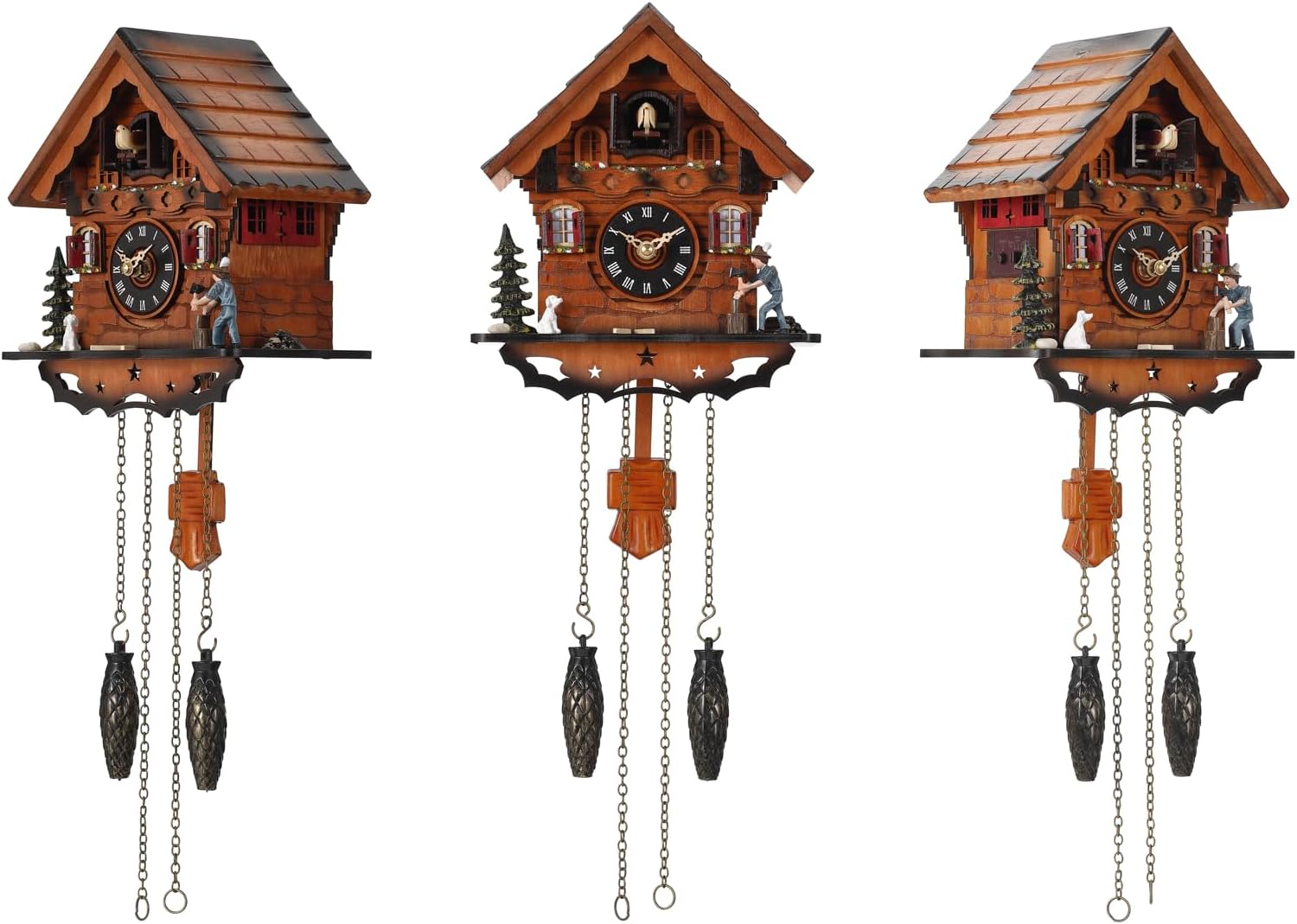
Kintrot
$95.99
In stock on Amazon
Check price on AmazonEngstler: The Mechanical-to-Quartz Trade-Up Pick
Engstler occupies a different position in the market. The brand has a longer manufacturing history than pure novelty players, and its quartz line carries more design fidelity to traditional Black Forest chalet styling — the kind of carved eaves and figural decoration that buyers associate with pieces from the Schwarzwald region. The regional craft traditions documented by schwarzwald-tourismus.info (Black Forest Crafts & Traditions overview) describe precisely this ornamental vocabulary: hand-carved relief panels, stag and hunter motifs, and the chalet roofline silhouette that Engstler’s quartz housings replicate at a lower price point than genuine mechanical pieces.
What distinguishes Engstler in the review record is the buyer profile. Owners who write long-form reviews of Engstler quartz models consistently describe prior mechanical clock ownership. They’re not new to cuckoo clocks; they’re simplifying. That context changes what they notice and report: movement reliability over time, sound quality of the cuckoo call, and how well the animated figures hold up to daily cycling. Reviews in this segment tend to be more analytical and less driven by “it’s so cute” affect.
The tradeoff Engstler buyers explicitly name: the quartz movement will never have the character of a mechanical. The pendulum swings on a motor rather than momentum. The cuckoo call comes from a speaker rather than a physical bellows. For buyers who’ve owned both, that’s a real loss — but it’s one they’ve consciously accepted in exchange for zero-maintenance operation.
Who Engstler fits: Former mechanical clock owners who want daily reliability without winding. Interior decorators sourcing for client spaces where maintenance calls aren’t practical. Mid-range gift buyers who want more design authenticity than the entry tier offers.
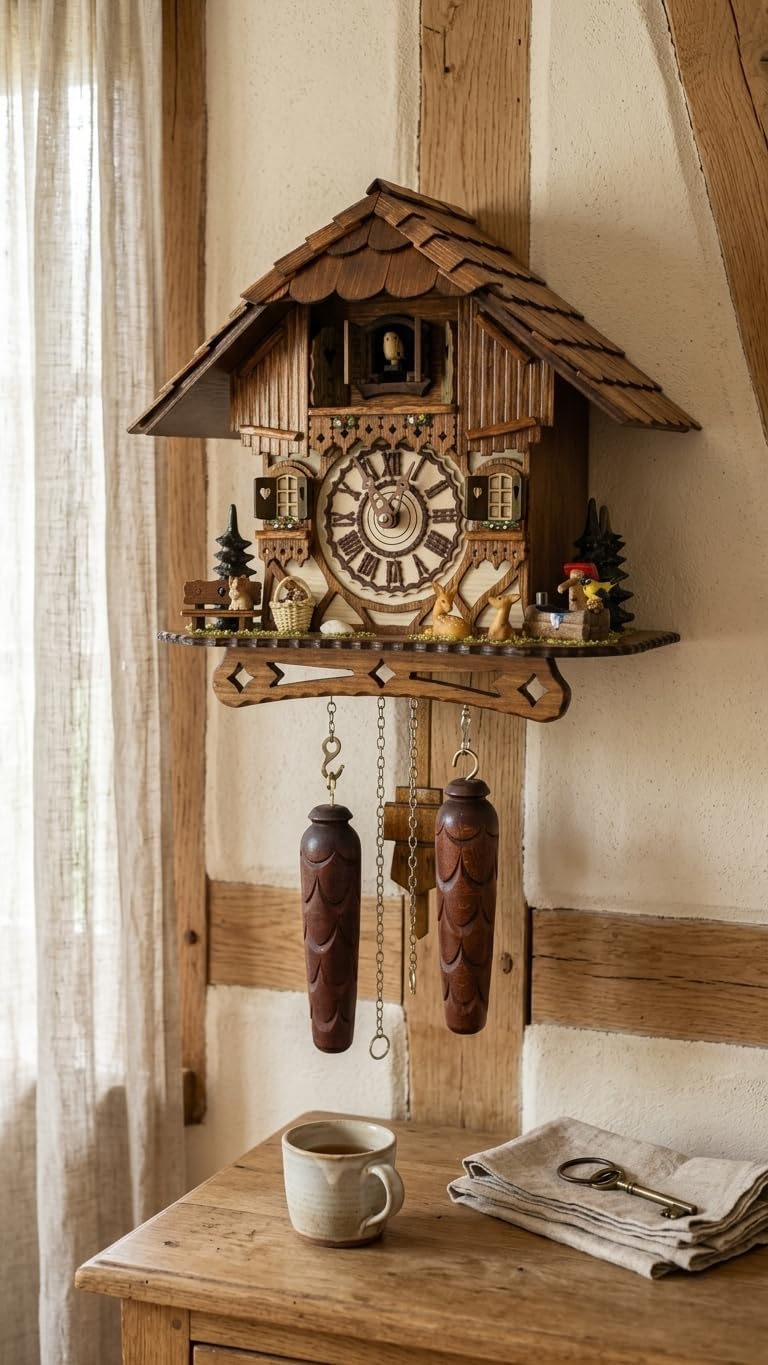
Cuckoo
$345.00
In stock on Amazon
Check price on AmazonCuckoo Palace: The Longitudinal Satisfaction Data Point
Cuckoo Palace is the outlier in this comparison for one reason: there’s a five-year ownership review on record expressing continued satisfaction with the product. In a category where most reviews come within the first 30 days of ownership, that’s unusually strong longitudinal data. Five years is long enough to have cycled through multiple battery sets, experienced seasonal humidity changes (relevant for wood or wood-composite cases), and observed whether the animated mechanisms maintain their calibration.
The Spruce’s cuckoo clock buying guide (thespruce.com, Cuckoo Clock Buying Guide) identifies long-term movement reliability and case integrity as the two most common failure points in quartz models at lower price tiers. A five-year positive outcome suggests Cuckoo Palace’s build quality clears at least a meaningful durability threshold — though one review is one data point, not a warranty.
What makes this worth weighting: most buyers in the quartz category are explicitly not buying for heirloom longevity. They’re buying for a five-to-ten year decorative horizon, possibly longer. A product that holds up through year five without degraded animation, cracked case trim, or failed electronics is delivering on the category’s implicit promise.
Who Cuckoo Palace fits: Buyers who want confidence in mid-run durability. Gift-givers selecting for a recipient who will actually use the clock daily for years rather than display it seasonally.
Cuckoo
$345.00
In stock on Amazon
Check price on AmazonTimegear: Attractive Finish, Unit Consistency Is the Watch-Out
Timegear enters the comparison as the value-end aesthetic play. The most-cited positive review on the model praises its wood-like finish — specifically that it reads as genuine wood rather than obviously plastic at normal viewing distance. That’s a real differentiator at this price point; many competitors in the tier have cases that look like painted resin under close inspection.
The problem sits right next to that five-star review in the aggregated record: a complaint that the cuckoo bird never emerged from its door. That’s a mechanism failure on arrival, and it points to unit-to-unit consistency as an unresolved risk at Timegear’s price tier.
If you receive a Timegear unit and the bird doesn’t emerge on the first hourly cycle:
- Confirm the clock is set to an actual hour position (some units only trigger the cuckoo at the top of the hour, not the half-hour, depending on mode).
- Check that the battery compartment is fully seated — a partially connected battery can power the clock face without fully engaging the animation motor.
- Manually advance the hands to the next hour position and wait through the full cycle.
- If the door doesn’t open after two full cycles, treat this as a mechanism defect and initiate a return or replacement immediately. Don’t wait out your return window hoping it resolves.
The wood-like finish is genuinely appealing and reviewers are right to flag it. But the bird-failure risk means Timegear is a higher-variance purchase than the other three — you may receive a perfect unit, or you may spend a week troubleshooting something that should have worked out of the box.
Who Timegear fits: Price-conscious buyers who prioritize aesthetics and are willing to accept some unit lottery risk. Not recommended for gifts being shipped directly to recipients without an intermediate inspection stop.
Kintrot
$95.99
In stock on Amazon
Check price on AmazonSide-by-Side Summary
| Brand | Primary Buyer Type | Key Strength | Key Risk | Tier |
|---|---|---|---|---|
| Kintrot | First-time / gift-giver | Price + animated variety | Water wheel paddle fragility in shipping | Kintrot — $95.99 |
| Engstler | Mechanical trade-down | Design fidelity, build credibility | Higher price; movement still electronic | Cuckoo — $345.00 |
| Cuckoo Palace | Durability-minded buyer | 5-year satisfaction on record | Smaller brand footprint, fewer reviews | Cuckoo — $345.00 |
| Timegear | Budget aesthetic buyer | Wood-like finish reads authentic | Bird-emergence mechanism inconsistency | Kintrot — $95.99 |
Frequently Asked Questions
Do any of these quartz cuckoo clocks have a night silence mode? Yes — this is a standard feature across the category, though the implementation varies. Most quartz models include either an automatic light sensor (the clock detects darkness and pauses calling) or a manual switch that silences the cuckoo between set hours. Check the product listing’s feature bullets for “night shutoff,” “automatic silence,” or “light sensor” language. If the listing doesn’t specify, assume manual-only and confirm before purchasing.
What batteries do these clocks take, and are they included? The majority of quartz cuckoo clocks with animation run on AA or C batteries — typically two to four cells depending on whether the animation motor runs separately from the timekeeping circuit. Batteries are almost never included at this price tier. Pull the battery requirement from the product spec sheet before gifting so the recipient isn’t waiting.
Is the case real wood or plastic, and how can I tell from the listing? Genuine wood cases will appear in the listing as “solid wood,” “linden wood,” or “basswood.” Composite or MDF cases are often described as “wood-finish,” “wood-look,” or left vague. Plastic cases may use “resin” or simply not address material at all. If the listing doesn’t specify material explicitly, assume composite or plastic and factor that into your expectations. Atlas Obscura’s article “The Surprisingly Contested History of the Cuckoo Clock” (atlasobscura.com) notes that even entry-tier traditional pieces historically used linden wood as the standard carving material — if a modern quartz listing won’t commit to naming the case material, that silence is itself informative.
What should I do if the cuckoo bird doesn’t come out of the door? Follow the four-step check described in the Timegear section above: confirm hour position, reseat batteries, advance hands manually to the next hour, and wait through two full cycles. If the bird still doesn’t emerge, initiate a return — don’t attempt to force the door mechanism open manually, as this risks snapping the plastic arm that drives the bird forward.
Can I turn the music off and keep just the cuckoo call? On models that include post-cuckoo music (Kintrot’s maple-leaf pendulum model is the primary example), yes — there is typically a switch on the back of the case that disables melody while keeping the cuckoo call active. Look for a switch icon or “music on/off” label. If you’re gifting this model, it’s worth noting the switch location in your gift message so the recipient knows the option exists.
The Decision Rule
If you’re buying for a first-time recipient who wants the full animated cuckoo clock experience at minimum friction — Kintrot, with the water wheel inspection protocol on arrival.
If you’re a former mechanical clock owner looking for daily reliability with real design credibility — Engstler is the straightforward call.
If your priority is confidence that the clock is still running well in year four or five — Cuckoo Palace’s longitudinal review record is the only data in the field that speaks to that directly.
If budget is the hard constraint and the wood-like aesthetic matters — Timegear, but only if you can inspect the unit yourself before it reaches the gift recipient.
The quartz category as a whole is right for buyers who’ve already decided that maintenance isn’t worth the charm premium. If you’re still on the fence about that trade-off, the Black Forest Crafts & Regional Traditions overview published by germanculture.com.ua is a useful starting point for understanding what the mechanical alternative actually offers — including the regional guilds, generational craft transmission, and movement-assembly standards that distinguish a certified mechanical piece — and whether that difference matters for your specific use case.