A cuckoo clock kit — in case this is your first encounter with the category — is a flat-pack of precision-cut wooden parts that you assemble yourself into a working mechanical clock, complete with a small bird that pops out and calls on the hour. The tradition behind these clocks runs deep: as Atlas Obscura’s profile of Black Forest clockmaking documents, the cuckoo clock has been a signature product of Germany’s Black Forest region since the 1730s, and the craft has been recognized as part of Germany’s intangible cultural heritage. What ROKR and ROBOTIME have done is reimagine that tradition as a hobbyist build experience — a wooden puzzle that ends with something you can actually hang on the wall. If you’re researching one of these kits as a gift, a personal project, or a bridge into mechanical woodcraft, this article maps exactly what builders report experiencing, where the kits earn their praise, and where the tradeoffs sit.
Who Actually Builds These, and Why That Matters for Your Decision
The buyer community for ROKR and ROBOTIME cuckoo kits splits cleanly into two camps, and knowing which camp you’re in shapes which kit deserves your attention.
Camp one: the experienced hobbyist. These are people who have built model ships, mechanical puzzles, or wooden automata before. Aggregated builder reviews of ROKR’s cuckoo clock kits include at least one hobbyist with 70 years of model-building experience who describes the ROKR kit as “the best quality I have seen” — a remarkable statement given the depth of comparison available to someone with that history. Another reviewer who had completed more than 60 kits from six different manufacturers placed ROKR and ROBOTIME at the top of their ranking. The Spruce’s roundup of best model kits for adults consistently identifies component fit and instruction clarity as the differentiating quality signals at this tier, and experienced builders in aggregated reviews echo that framing precisely.
Camp two: the confidence-builder. This is where the narrative gets more instructive. One documented buyer purchased the ROBOTIME cuckoo clock kit specifically to rebuild their confidence after a frustrating experience with a different, more complex ROKR product — one that had apparently left them discouraged. That they returned to the ROKR and ROBOTIME ecosystem rather than abandoning it entirely is a meaningful data point. It suggests the cuckoo clock occupies a sweeter spot in the difficulty curve than some of the brand’s more ambitious offerings.
The practitioner-level implication: if you’re sourcing these as gifts for someone new to mechanical kits, the cuckoo clock is a better entry point than the most complex builds in either brand’s catalog. If you’re buying for an experienced hobbyist, the quality ceiling is high enough that even veteran builders report genuine satisfaction.
The Build Experience: What the Sequence Actually Feels Like
Based on what builders consistently describe across aggregated reviews, the build arc follows a recognizable pattern.
Early stages involve sorting and dry-fitting parts — the laser-cut wooden sheets from which individual pieces are punched out. Builders note the fit tolerance is tight enough that pieces seat without play, but not so tight that force is required. This is the specification that separates a well-made kit from a cheap import, and it is where ROKR and ROBOTIME earn their reputation.
Mid-build is where the mechanical complexity emerges. The gear trains, escapement (the ticking mechanism that regulates the clock’s speed), and cuckoo activation linkage all come together in a sequence that requires patience and close attention to the instruction manual. Builders consistently flag this phase as the one most likely to generate frustration if steps are skipped or only partially completed.
The critical quality signal that experienced builders call out: ROKR’s cuckoo kits allow electronics testing mid-build. This matters more than it might sound. A different ROKR product — not the cuckoo clock — drew a negative review specifically because a motor failure could not be detected until after a critical assembly step, effectively trapping the builder with a defective component buried inside a nearly completed structure. The cuckoo kit’s design allows you to verify that the cuckoo mechanism and motor are functioning before you close up the case. For gift-givers sourcing these for someone else, this builder-friendly design decision separates a thoughtful kit from a potentially frustrating one.
The emotional peak that reviewers describe with near-universal consistency is the moment the pendulum swings freely for the first time, or — better yet — when the cuckoo calls on the first hour strike. DW’s feature on Black Forest clockmaking history notes that the cuckoo call has been a source of delight for nearly three centuries; builders of these kits report that the feeling of having made that happen themselves adds a dimension that purchasing a finished clock cannot replicate.
Comparing the Kits: Three Build Profiles Worth Knowing
Not every kit in the ROKR and ROBOTIME cuckoo ecosystem occupies the same position. The three profiles below represent the primary options builders encounter and deliberate between.
The Painted Finish Cuckoo Clock
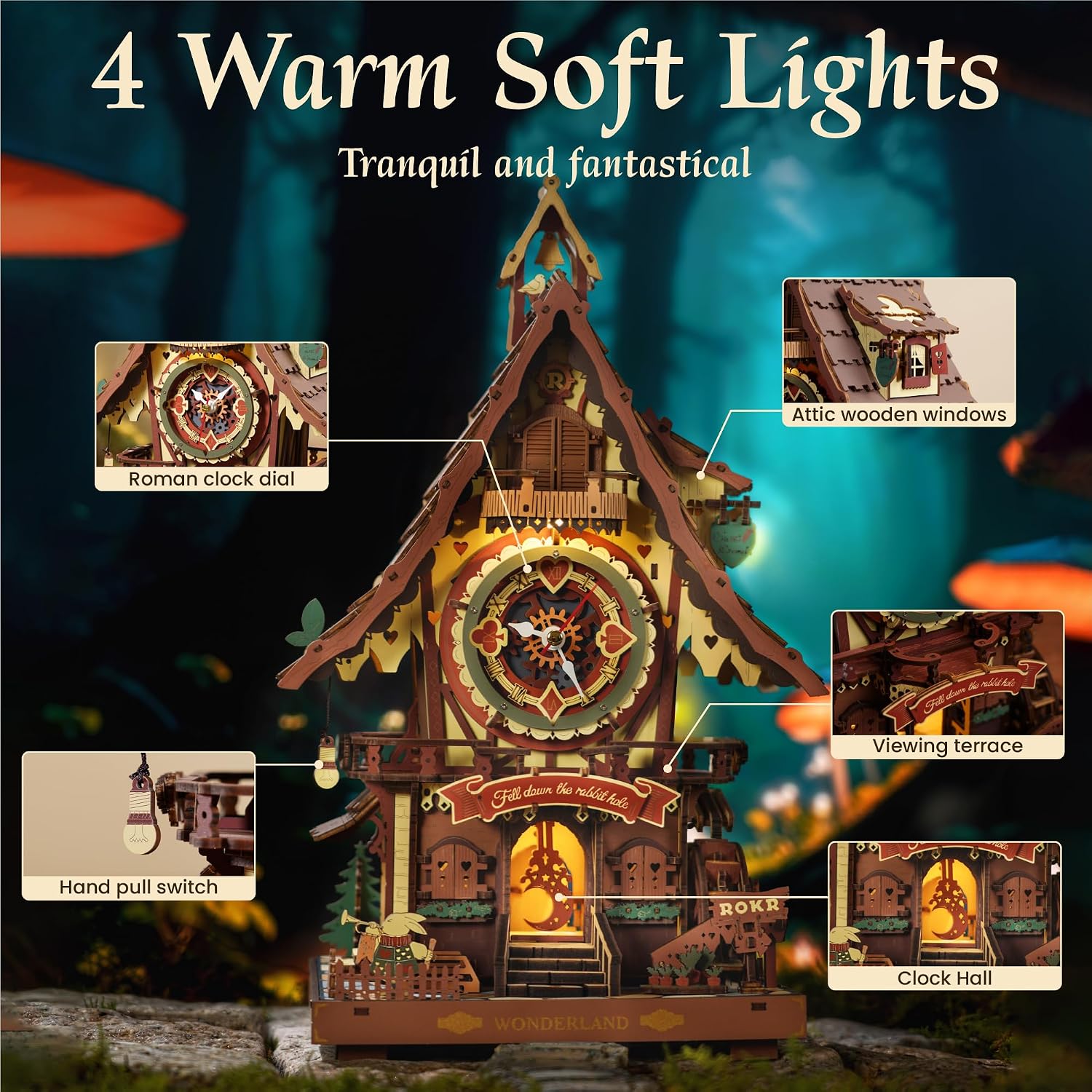
The painted version of the ROKR cuckoo clock features pre-applied color on the decorative surfaces, giving the finished piece an immediately festive, folk-art character. Builders who compare painted and natural-finish versions directly tend to describe the painted variant as “much cuter” — a word choice that signals something about the appropriate audience. Painted finishes read as more playful, more gift-appropriate, and more immediately celebratory.
Smithsonian Magazine’s coverage of Black Forest cuckoo clock history notes that the decorative painting tradition on these clocks draws from regional folk art motifs — florals, wildlife, and alpine scenes — that have been part of the form since the 19th century. The painted kit connects to that lineage in a way that feels deliberate rather than arbitrary.
Best for: gift contexts, children’s rooms, holiday gifting, anyone who wants the finished piece to read as a delight the moment it goes on the wall.
ROKR
$69.99
In stock on Amazon
Check price on AmazonThe Natural Wood Finish Cuckoo Clock
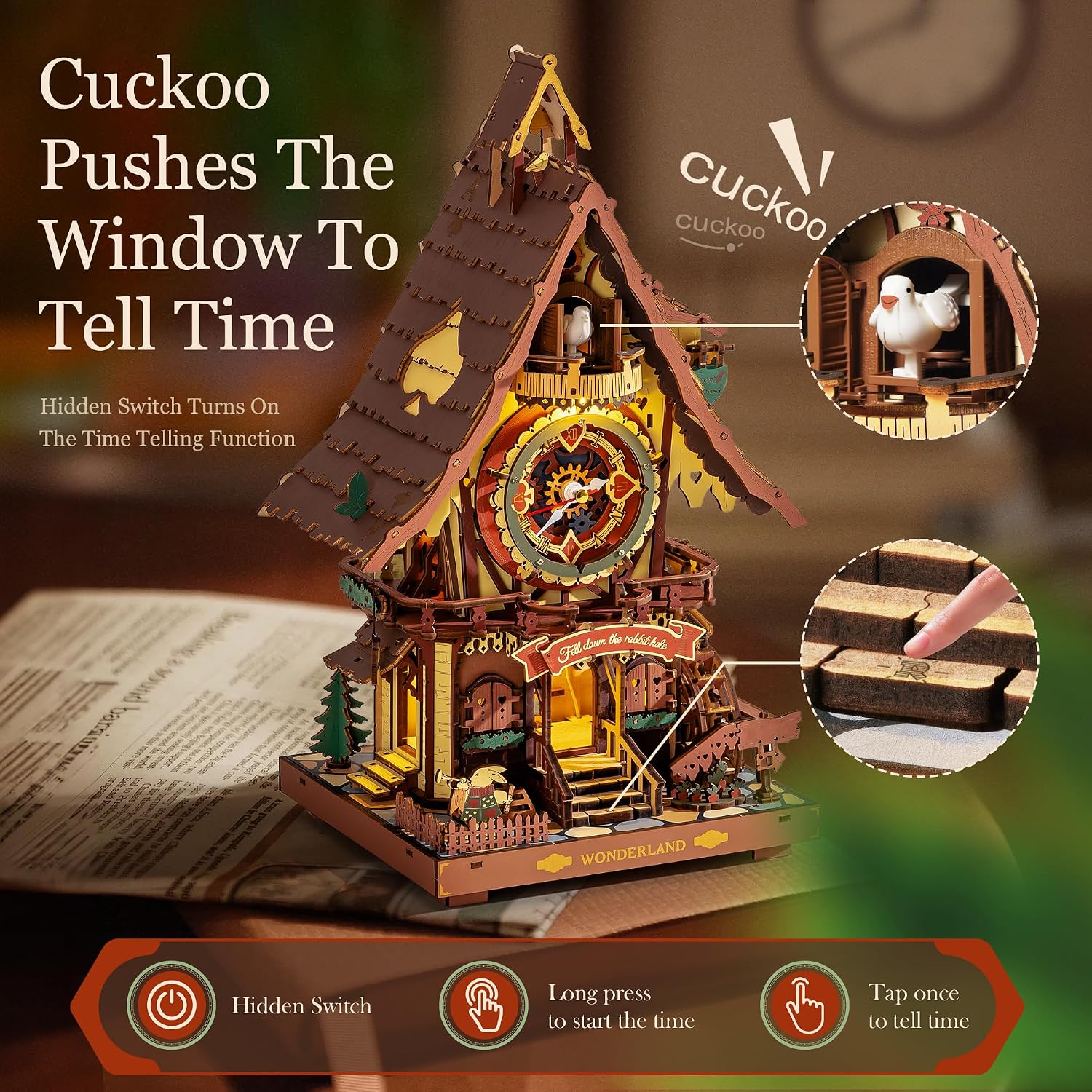
The natural wood finish variant lets the laser-cut grain of the wooden components remain the primary visual statement. Builders with backgrounds in serious woodcraft or heritage-adjacent décor tend to prefer this version. It reads as more considered, more aligned with the craft tradition that connects these kits to authentic Black Forest work.
Atlas Obscura’s profile of Black Forest clockmaking notes that the earliest cuckoo clocks from the 1730s were unadorned wood — the painting tradition came later — so if anything, the natural finish has the longer historical lineage. Neither finish is more authentic in an absolute sense; the choice is purely about display context and personal aesthetic.
Best for: adult craft rooms, heritage-themed interiors, display alongside serious woodcraft pieces, buyers who want the build process itself to be the visible story.
ROBOTIME
$69.99
In stock on Amazon
Check price on AmazonThe ROBOTIME Cuckoo Clock Kit
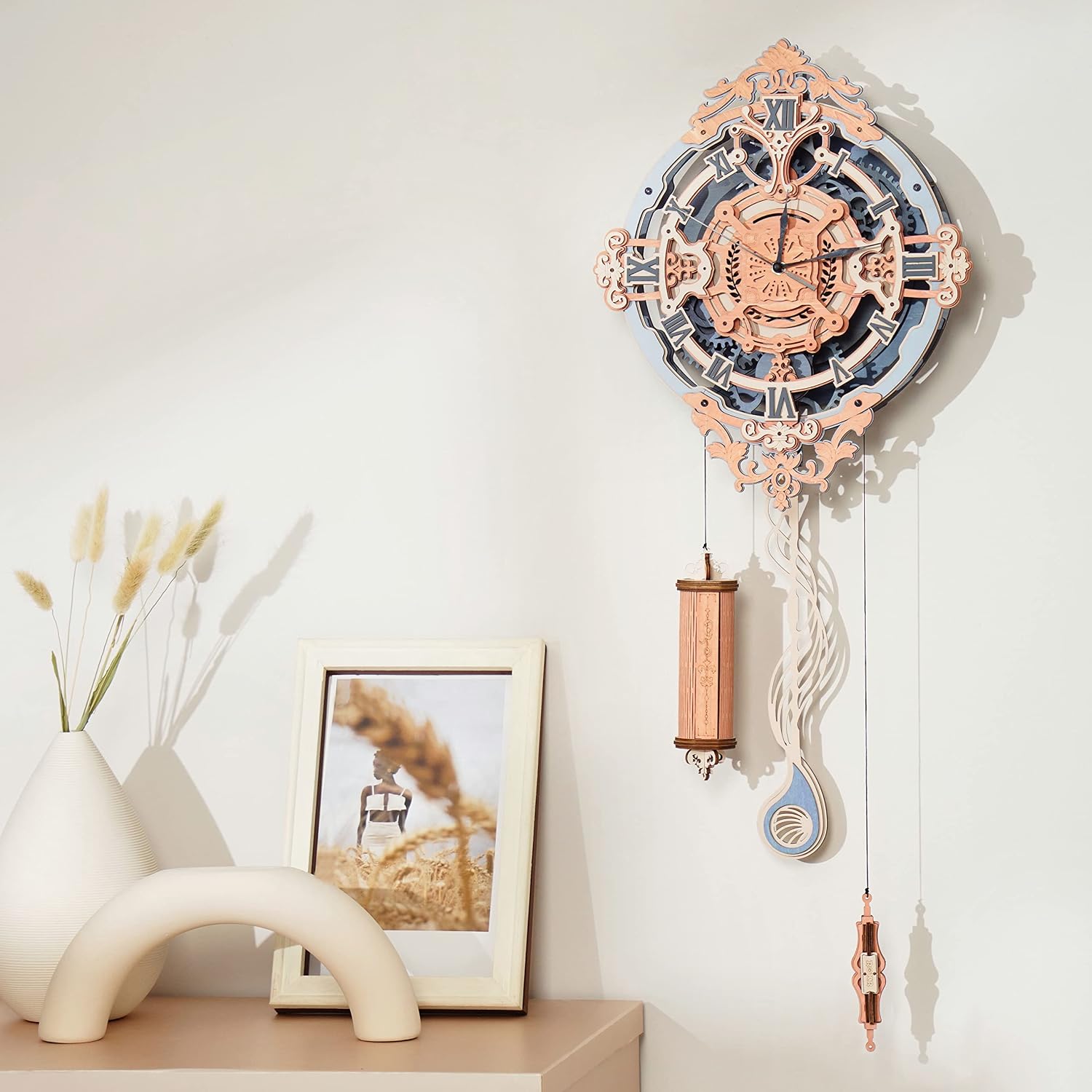
The ROBOTIME cuckoo clock kit occupies a distinct position in this ecosystem: it is the version most consistently recommended as an accessible entry point, and the one that draws buyers who have had difficult experiences elsewhere and want a confidence-restoring build. Builders describe the instruction sequencing as particularly clear and the component tolerances as forgiving enough that first-time builders do not feel penalized for minor imprecision.
The Spruce’s overview of adult model kits positions laser-cut wooden mechanical kits as appropriate for ages 14 and up with adult supervision, and for independent adult builders at any experience level. The ROBOTIME cuckoo kit sits comfortably within that accessibility profile.
Best for: first-time mechanical kit builders, buyers recovering confidence after a difficult kit, gift recipients whose experience level is uncertain.
ROKR
$64.99
In stock on Amazon
Check price on AmazonThe Runtime Limitation You Need to Understand Before You Buy
The ROKR pendulum clock — a related product in the same brand ecosystem, distinct from the cuckoo clock kits — carries a specific limitation that deserves clear treatment here: it runs for approximately 2.5 hours on a single wind due to string length constraints inherent to its compact scale.
This is not a defect. It is a design consequence. But it is a meaningful tradeoff that changes how you should frame the product. A clock that runs 2.5 hours is not a functional timekeeper in the way a wall clock is. It is a mechanical demonstration piece — something you wind up to show guests, or run during an activity, and then reset. Builders who go in expecting a continuously running clock report disappointment. Builders who frame it as a kinetic conversation piece report satisfaction.
For the cuckoo clock kits specifically, this runtime concern does not apply in the same way — the cuckoo mechanism is battery-driven rather than purely spring-and-string — but understanding this distinction across the product line helps you set accurate expectations for whoever is receiving or building these kits. The pendulum clock is worth knowing about as a companion or alternative gift option; just go in with the right frame.
Frequently Asked Questions
Does the ROKR cuckoo clock kit function as a real working clock? Yes, with qualifications. The cuckoo mechanism and timekeeping function both work, but the primary value is the build experience and the display piece that results. Builders consistently describe it as functional rather than precision-accurate — the cuckoo calls on the hour as designed, but you would not rely on it the way you would rely on a quartz wall clock.
How long does it take to build a ROKR or ROBOTIME cuckoo clock kit? Aggregated builder reviews suggest 4–8 hours for most adults, spread across one or two sessions. Experienced model-builders with tight component-fitting intuition land toward the lower end. First-time builders or those who read instructions carefully land toward the higher end. Rushing the mid-build mechanical assembly is the most commonly cited cause of errors that require backtracking.
Is the painted or natural wood finish version better for display? Neither is objectively superior — the decision is context-dependent. Painted finishes read as more playful and festive; natural wood finishes read as more serious and heritage-aligned. A buyer who compared both directly called the painted version “much cuter,” which is useful signal for gift contexts. Smithsonian Magazine’s coverage of Black Forest decorative tradition supports both as historically grounded choices.
What skill level or age is appropriate for these kits? The Spruce’s overview of adult model kits positions laser-cut wooden mechanical kits as appropriate for ages 14 and up with adult supervision, and for independent adult builders at any experience level. The cuckoo clock kits specifically have earned praise from builders with decades of experience, which suggests the difficulty curve is engaging without being exclusionary.
Can the ROKR pendulum clock run continuously or does it need rewinding? The ROKR pendulum clock requires rewinding approximately every 2.5 hours due to string length limitations. It is best understood as a demonstration piece rather than a continuously running timekeeper. The cuckoo clock kits use battery-driven mechanisms and do not carry the same runtime constraint.
What happens if a piece is defective or missing from the kit? ROKR and ROBOTIME both maintain customer service channels for replacement parts. Builders consistently note that the brands are responsive to defect claims. The design advantage of the cuckoo kits — specifically the ability to test electronic components mid-build — means defects in the cuckoo mechanism are more likely to surface before assembly is complete, rather than being discovered only after the clock is fully closed.
The If-Then Decision Frame
If you’re sourcing a ROKR or ROBOTIME cuckoo kit for an experienced hobbyist who has built other mechanical wooden kits, the evidence from aggregated builder reviews supports this as a top-tier choice in its category — builders with 70 years of experience and more than 60 comparative builds confirm the quality ceiling is real. The natural wood finish variant suits this buyer best.
If you’re sourcing it for a first-time builder or someone rebuilding confidence after a difficult kit experience, the ROBOTIME cuckoo clock represents the more accessible entry point, and the mid-build electronics testing feature removes the most frustrating failure mode in the category.
If the display context is festive or gift-oriented, go painted. If it’s heritage or craft-room oriented, go natural wood.
And if someone asks whether these kits belong in the same conversation as authentic hand-carved Black Forest cuckoo clocks — they don’t, and that’s fine. As DW’s coverage of German craft traditions documents, the cuckoo clock has always occupied multiple market tiers simultaneously. These kits are their own thing: participatory craft objects that produce a real mechanical result and a genuine moment of satisfaction. The first cuckoo call, builders report, earns it.