If you have ever looked at a traditional Black Forest cuckoo clock — the carved wooden kind where a small bird pops out to announce the hour — and wondered how all those interlocking gears and levers actually work, these kits are the hands-on answer. ROKR and ROBOTIME (the two brand names are related; ROKR is the flagship product line sold under the ROBOTIME parent company) produce laser-cut wooden puzzle kits that assemble into functional mechanical clocks. Unlike a static model, these finished pieces actually run: the pendulum swings, the gears turn, and — in the cuckoo variants — a small bird emerges on a spring-loaded arm. For gift-givers in our community, these kits occupy an interesting middle position: they are more engaging than a decorative ornament and more accessible than a $400-plus hand-carved collector clock, yet they deliver a version of the same emotional payoff that makes cuckoo clocks so enduring in the first place. This article breaks down the two primary kits — the ROKR Cuckoo Clock (model LK601) and the ROBOTIME Pendulum Clock (model LK502) — so you can match the right build to your buyer, your skill level, or your gift recipient.
What You Are Actually Comparing: Two Kits, Two Mechanical Philosophies
Before getting into decision-making, it helps to understand what separates these two kits at a mechanical level, because the differences are not cosmetic — they shape the entire build experience.
The ROKR Cuckoo Clock (LK601): Premium Build, Maximum Payoff
This is the more complex and more celebrated of the two kits. The mechanism is gravity-driven: a set of hanging weights powers the gear train, which in turn drives the timekeeping escapement and triggers the cuckoo arm. Across aggregated builder accounts through mid-2026, the pattern is consistent. Reviewers describe the build sequence as logical and well-paced, with printed instructions supplemented by a QR code linking to video tutorials — a detail multiple builders call out as genuinely useful rather than a throwaway addition. One reviewer who has assembled more than 60 wooden model kits from six different manufacturers rates this specific kit as the best they have ever built across all dimensions: instruction clarity, part fit, mechanical satisfaction, and finished quality. That is a meaningful signal from someone with a calibrated reference set.
Build time for the full cuckoo kit runs approximately six hours for a builder working at a steady pace, according to multiple independent builder accounts. That figure matters for gift-givers: this is not an afternoon project. Plan for a full day, spread across sessions, or a dedicated weekend build.
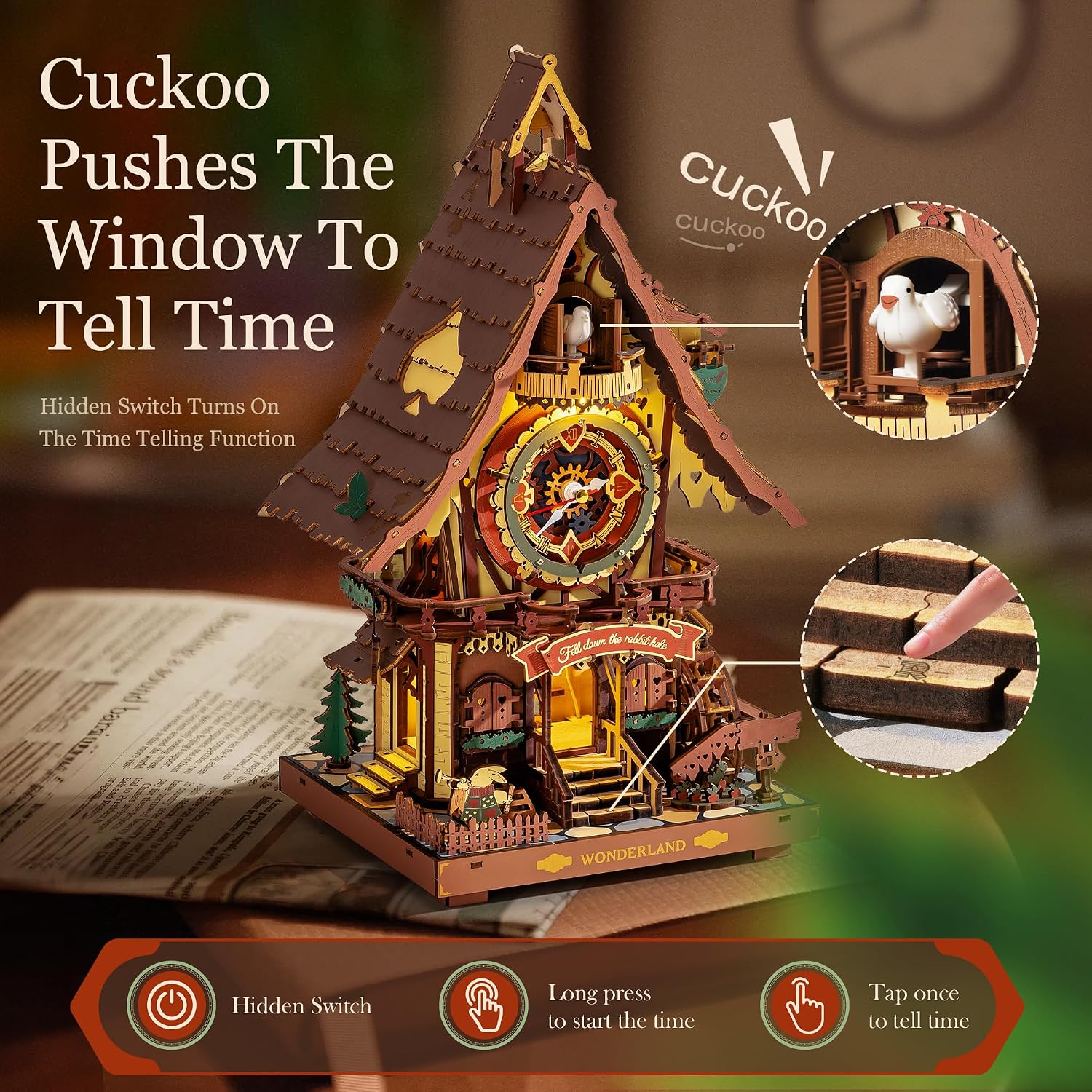
ROBOTIME
$69.99
In stock on Amazon
Check price on AmazonThe ROBOTIME Pendulum Clock (LK502): Shorter Build, Known Frustration Point
This is the lighter sibling. The mechanics are simpler — a pendulum-regulated movement rather than a weight-driven gear train — and the build is correspondingly less demanding. However, this kit surfaces a specific and documented frustration worth naming plainly: multiple builders report that the pendulum will not swing reliably without adding significant external weight to the pendulum bob. At least one builder rebuilt the entire mechanism and watched the video tutorial multiple times without resolving the issue, ultimately switching to the battery-driven backup clock module that ships in the box as a fallback. This is not a fringe complaint. It is a recurring pattern across enough independent accounts that it should factor into your buying decision.
The tradeoff is clear: the cuckoo clock is harder to build and more rewarding to finish. The pendulum clock is easier to start but carries a non-trivial risk of mechanical frustration at the end.
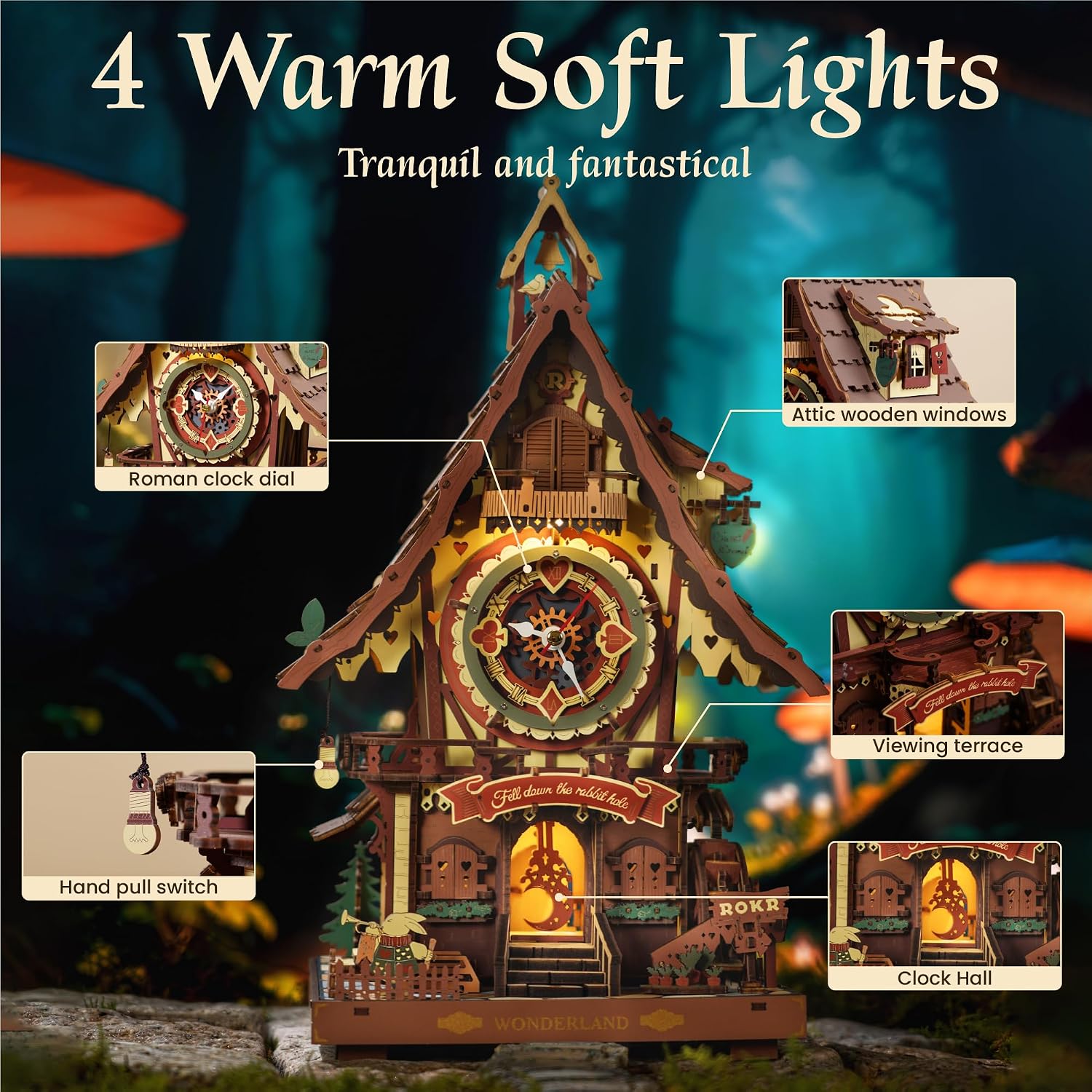
ROKR
$69.99
In stock on Amazon
Check price on AmazonChoosing Between Them: Entry-Level Considerations
For a first-time kit builder who wants a genuine introduction to wooden mechanical assembly without the full six-hour commitment, each kit comes with honest caveats. The cuckoo clock demands more patience and prior model experience. The pendulum clock is a lower barrier to entry, provided the buyer knows in advance about the pendulum weight issue and treats the included battery module as a legitimate fallback rather than a failure. Understanding both options clearly is the starting point for a good gift decision.
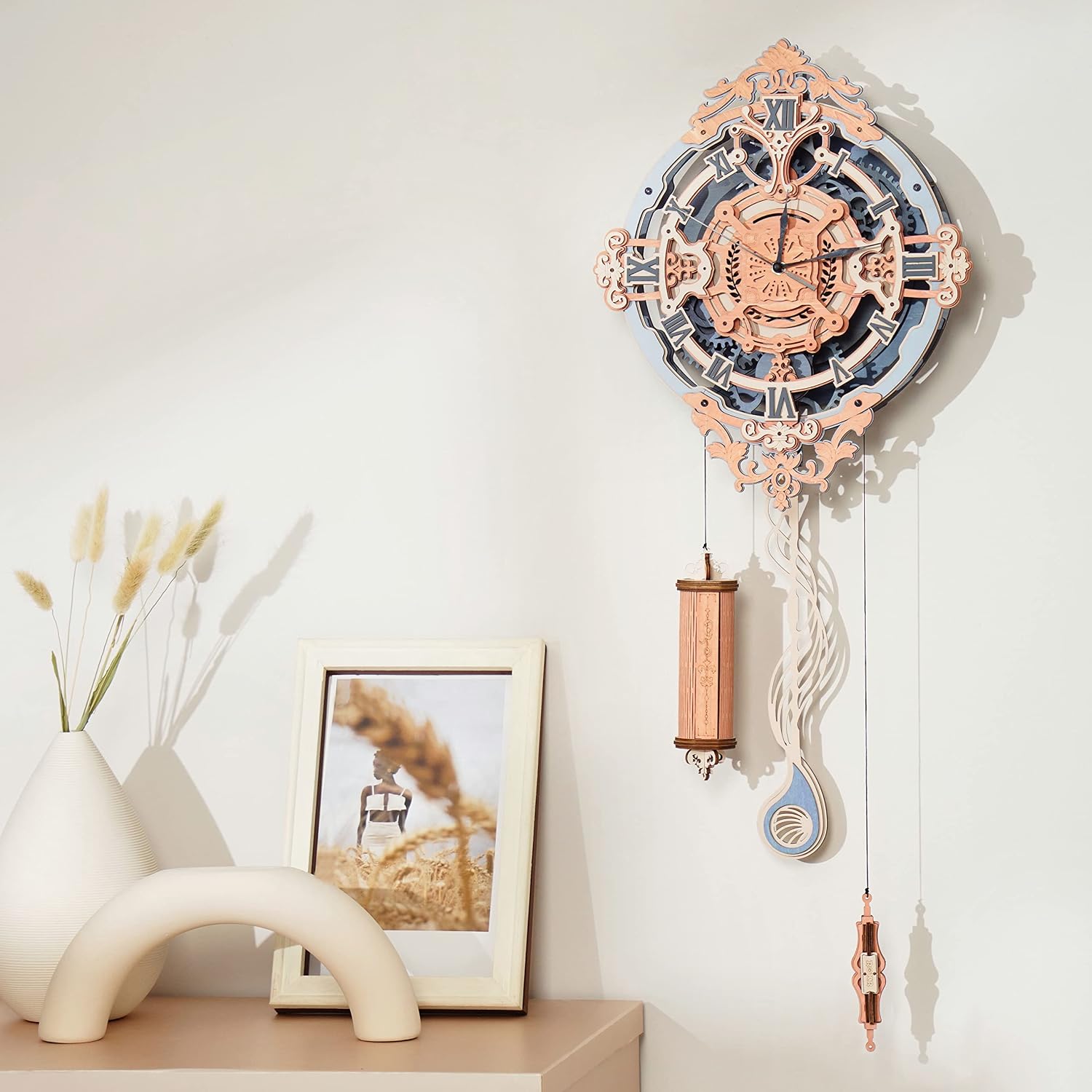
ROKR
$64.99
In stock on Amazon
Check price on AmazonBy the Numbers
| Feature | ROKR Cuckoo Clock (LK601) | ROBOTIME Pendulum Clock (LK502) |
|---|---|---|
| Estimated build time | ~6 hours | ~3–4 hours |
| Primary drive mechanism | Hanging weights (gravity) | Pendulum + battery fallback |
| Reported “won’t run” complaints | Rare | Moderate (pendulum weight issue) |
| Battery backup included | No | Yes |
| Age floor (skill-appropriate) | Teen (13+) with adult supervision | Teen (13+) independent |
| ”Best kit I’ve built” endorsements | Multiple, including a 60+ kit veteran | Few |
ROBOTIME
$69.99
In stock on Amazon
Check price on AmazonROKR
$69.99
In stock on Amazon
Check price on AmazonROKR
$64.99
In stock on Amazon
Check price on AmazonWho Actually Builds These Kits? The Age Range Is Wider Than You’d Expect
One of the more striking data points in the builder community surrounding the ROKR Cuckoo Clock (LK601) is an 80-year-old builder who completed the kit and reported genuine satisfaction with both the process and the result. This is worth pausing on, because the marketing imagery for wooden puzzle kits tends to skew toward younger hobbyists — teens, college students, people who also buy mechanical keyboards and 3D printers. The actual buyer population is broader.
Wirecutter, published by The New York Times Company, has covered mechanical puzzle kits and wooden model builds in its gift guide for puzzle lovers, consistently noting that step-by-step mechanical builds cross generational lines and are appropriate for older adults who enjoy fine motor challenges. Apartment Therapy’s feature “Wooden Model Kits Are the Meditative Hobby You Didn’t Know You Needed” frames the category similarly: the satisfaction is about the process of assembly, not about familiarity with technology or youth culture.
For gift-givers, this expands the viable recipient list considerably. A retired hobbyist with steady hands and patience for detail is, if anything, better positioned to enjoy this build than an impatient teenager looking for quick gratification. The cuckoo kit in particular rewards methodical builders who read instructions before acting and who will not rush the gear-seating steps.
That said, the complexity is real. The ROKR Cuckoo Clock is not a beginner kit. Builders consistently note that it requires careful attention to part orientation during the gear train assembly, and that mis-seating a gear early in the build creates problems that are difficult to diagnose later. For a first-time wooden kit builder, the pendulum clock is the safer entry point — frustrating pendulum physics notwithstanding — because the consequences of assembly errors are less deeply embedded in the mechanism.
Authenticity Context: Where These Kits Sit Relative to Traditional Cuckoo Clocks
It is worth being transparent about what these kits are and are not, especially for readers who come to this site as collectors or heritage enthusiasts.
Traditional Black Forest cuckoo clocks — the kind bearing the VdS (Verein die Schwarzwalduhr, or Black Forest Clock Association) certification label — are hand-assembled in Germany’s Black Forest region, often incorporating carved linden wood cases, brass movements, and mechanisms that can run for 30 years with periodic maintenance. DW (Deutsche Welle), in its reporting titled “Black Forest Cuckoo Clocks: A Tradition Under Pressure,” notes that certified authentic pieces must meet regional origin standards for both movement and case production. Smithsonian Magazine, in its feature “The Art of the Cuckoo Clock,” traces the tradition to 18th-century Triberg and frames the craft as a living regional identity, not merely a decorative genre.
ROKR and ROBOTIME kits are not in that category. They are laser-cut plywood products. They do not carry regional craft certifications, and they are not positioned as collector investments. What they are is an accessible mechanical puzzle that teaches the principles behind cuckoo clock mechanics — the escapement, the gear train, the weight-driven power delivery — in a format that produces genuine understanding and genuine satisfaction when it works. For a gift-giver choosing between a $20 decorative ornament and a $400-plus Kahlert or Anton Schneider movement clock, these kits occupy a thoughtful middle ground: more engaging than a passive souvenir, more affordable than a serious collector piece, and genuinely educational about why the traditional clocks are worth the price.
Think of them as a gateway experience. Buyers who build one of these kits and find themselves wanting more — better wood, more precise gears, real mechanical craftsmanship — are exactly the audience that discovers what a hand-carved certified Black Forest movement clock actually represents.
Frequently Asked Questions
How long does it take to build the ROKR cuckoo clock kit from start to finish? Builders consistently report approximately six hours for the full build, typically spread across two or more sessions. Plan for a full day if you want to finish in one sitting, and budget extra time for careful gear alignment steps.
What tools or supplies do I need that are not included in the box? The kits are designed to be self-contained — parts punch out of laser-cut sheets and the tolerances are tight enough that many builders complete them without adhesive. However, builders recommend having fine-point tweezers on hand for small part placement, and a few drops of wood glue for any joints that feel loose. No painting supplies are required unless you choose to finish the natural wood version yourself.
Is this kit appropriate as a gift for a teenager, or is it genuinely adult-level complexity? The cuckoo clock kit is realistic for a motivated teenager aged 13 and up, particularly one with prior experience building models or working with fine detail. It is not appropriate for younger children or for casual builders expecting quick assembly. Adult supervision is recommended for the gear train stages regardless of age.
If the pendulum will not swing after assembly, what should I try first? This issue surfaces specifically on the pendulum clock kit (LK502), not the cuckoo clock. Based on patterns across multiple builder accounts: first, check that the pendulum bob is fully seated and that the suspension spring is correctly tensioned — even a small misalignment here dampens the swing amplitude significantly. Second, try adding external weight to the pendulum bob using small metal washers or coins taped temporarily to test the effect. If the mechanism still will not sustain oscillation after adjusting weight and re-checking the escapement pallet, the battery-driven backup module included in the box is a legitimate fallback, not a consolation prize.
Does the finished clock keep accurate time for daily use, or is it primarily decorative? Builders are candid here: these are hobbyist mechanical builds, not precision timekeepers. The wood escapement is subject to humidity and temperature variation, and timekeeping accuracy is approximate. Most builders treat the finished piece as a display item that also runs, rather than a daily-use clock. The battery module backup on the pendulum kit keeps accurate time; the weight-driven cuckoo mechanism is more variable.
What is the difference between the colored and natural wood finish versions? ROKR offers both natural (unfinished birch plywood) and pre-colored versions of select kits. In the colored versions, the tinting is applied at the factory to the laser-cut sheets before assembly — you are not painting individual parts. The natural wood version produces a lighter, more uniform aesthetic that some builders prefer to finish themselves with stain or wax after assembly. Neither version requires painting as part of the build process.
The Decision Rule
If the builder has prior model kit experience and wants the most satisfying mechanical payoff: choose the ROKR Cuckoo Clock (LK601). The six-hour build, the weight-driven mechanism, and the cuckoo trigger represent a genuine mechanical education, and the builder consensus — from a 60-kit veteran to an 80-year-old first-timer — is that it delivers on every dimension.
If the builder is a first-time kit assembler, a younger teenager, or someone who wants a shorter commitment with a battery fallback available: choose the ROBOTIME Pendulum Clock (LK502), but brief them in advance on the pendulum weight issue so it does not land as a failure.
And if they find they want more after finishing either kit — more precision, more craft, more permanence — that is the moment to introduce them to what a certified Black Forest movement clock actually represents. As both Wirecutter’s puzzle gift coverage (The New York Times Company) and Apartment Therapy’s meditative hobby reporting make clear in plain text, the best gateway into a lasting hobby is one that meets the builder exactly where they are.