Seasonal and Themed Beer Steins as Annual Gifts: Fall, Winter, and Occasion Scenes Worth Collecting
A beer stein — at its simplest, a handled drinking vessel with a hinged lid, typically made from ceramic, stoneware, or glass — has been a fixture of German festive culture for centuries. The lid was originally a public-health response to keep flies out of open drinks during plague-era Germany; today it’s the detail that makes a stein feel ceremonial rather than just utilitarian. Seasonal and themed steins take that tradition a step further: they carry painted or relief-molded scenes of Oktoberfest crowds, winter forest landscapes, eagles and heraldic crests, or Christmas market imagery. For the buyer who already understands the basics and is now deciding which stein to buy, why certain price points matter, and whether a themed series is genuinely worth building year over year — this guide is written for you. We’ve researched the field extensively, aggregated owner reviews, and mapped the tradeoffs at each tier so you can make a confident call.
Why Annual Themed Steins Have Become a Legitimate Collecting Habit
Reviewers of fall and winter scene steins describe a pattern that’s worth naming directly: they don’t buy one. They buy one per year, either as an Oktoberfest prize, a holiday gift, or a personal seasonal marker. DW (Deutsche Welle) has reported on how Oktoberfest merchandise — including quality steins — functions as a souvenir category with year-over-year repeat purchase behavior, not unlike holiday ornaments. That parallel is useful. The ornament collector’s mindset maps cleanly onto the seasonal stein buyer: the piece marks a year, an occasion, or a relationship, and the series accumulates meaning over time.
This is where themed steins diverge from generic barware. A 0.5L generic mug from a home goods store has no acquisition story. A fall harvest scene stein purchased at a Christkindlmarkt in 2024 and a Munich panorama stein gifted for a milestone birthday in 2025 are two chapters in a shelf narrative. For the gift-giver, that narrative is the product.
The tradeoff is obvious: themed steins at the novelty tier ($18–$45) are mass-produced, often finished overseas, and the quality gap between a beautiful painted exterior and a mediocre lid becomes apparent fast. At the mid-range ($80–$150), the materials improve — thicker stoneware, better pewter alloys, tighter hinge tolerances — but you’re still buying primarily for aesthetics, not heirloom longevity. Above $200, you’re entering hand-painted or limited-edition territory where collector resale dynamics start to apply.
By the numbers — sizing the seasonal stein market:
- Entry novelty tier: $18–$45 (painted ceramic, imported finishing, mass-scale)
- Mid-range collectible: $80–$150 (stoneware or quality ceramic, improved pewter lids)
- Serious collector / limited edition: $200–$500+ (hand-painted, signed, German-origin stoneware)
- Repeat-purchase rate among Oktoberfest souvenir buyers: anecdotally high — reviewer threads consistently show 3–7 steins purchased by a single buyer over consecutive seasons
The HAUCOZE Line: Strong Aesthetics, Real Quality Caveats
The HAUCOZE Eagle and Coats of Arms steins are among the most consistently reviewed seasonal-themed steins in the entry-to-mid tier. Owners repeatedly praise the color saturation and relief detail — the heraldic imagery reads as genuinely Germanic rather than as clip-art applied to ceramics. For a gift in the $30–$55 range, that visual impression is doing a lot of work.
Two issues come up with enough consistency to address directly.
The white powder issue. Multiple owners of new HAUCOZE ceramic steins have reported finding a fine white powder inside the vessel when they first unpacked it. This is a standard manufacturing residue — typically kiln release agent, clay dust from the firing process, or talc used during mold separation. It is not a defect and it is not a health concern if you wash the stein before use. The Spruce’s guidance on ceramic and stoneware care is unambiguous: any new ceramic vessel should be hand-washed with warm water and mild dish soap before first use, regardless of whether visible residue is present. Rinse thoroughly. The powder dissolves easily and leaves no aftertaste.
The 1.0L lid ergonomics. On the HAUCOZE 1.0L Munich scene stein specifically, a recurring reviewer complaint is that the pewter lid doesn’t open wide enough for comfortable drinking, and at least one documented owner attempted to force it open — a reliable way to stress the hinge pin. This is an ergonomic design tradeoff inherent to heavier lids on large-format steins: a 1.0L vessel filled with liquid is heavy, and if the lid spring is stiff to compensate for the added weight, thumb-lever pressure becomes awkward. The decision rule here is straightforward: if the stein is primarily for display or gifting as a decorative object, the 1.0L format is visually impressive and the lid function is secondary. If the recipient intends to drink from it regularly, the 0.5L or 0.55L format will be significantly more ergonomic. Don’t buy the 1.0L for a daily drinker unless they have confirmed they’re comfortable with the heft.
Personalized Steins: The Lid Corrosion Problem Nobody Advertises
The HomeWetBar personalized engraved stein sits in an interesting position: owners who focus on the engraving quality rate it highly, consistently noting that the customization is subtle and well-executed rather than looking like laser-etched afterthought. That’s legitimate praise — personalized engraving at this price point often looks cheap, and when it doesn’t, it matters to gift-givers.
The problem is the lid. A documented 1-star review cites corrosion and pitting on the pewter lid after normal use — a failure mode that sharply contradicts the positive engraving reviews. This is not a contradiction; it reflects two different quality-control vectors. The engraving process and the lid sourcing are almost certainly handled by different suppliers, and at the personalized tier, lid metal quality is the variable most likely to cut corners.
How to think about this tradeoff: If you’re buying the HomeWetBar stein as a display piece — a personalized gift that will sit on a shelf and be admired rather than used — the lid corrosion risk is largely irrelevant. If you’re buying it for a recipient who will actually pour beer into it and use the lid, you need to assess the pewter quality before purchase. See the FAQ section below for exactly how to do that.
The broader lesson for the practitioner-level buyer is this: at the personalized/engraved tier, always evaluate lid and body quality independently. A beautiful engraved body can ship with a mediocre lid. Review language that praises “the engraving” without mentioning lid function is incomplete information.
Helko Werk Stoneware: What “The Real Thing” Actually Means
The Helko Werk stoneware stein has a thin review base compared to the HAUCOZE line, but the language owners use is remarkably consistent: “the real thing,” “hefty,” “feels like what I picked up in Munich.” Per Atlas Obscura’s coverage of Bavarian drinking culture, the Masskrug — the traditional 1-liter stoneware stein of Oktoberfest — is defined as much by tactile weight and the sound it makes when set on a table as by its visual appearance. Helko Werk reviewers are describing exactly that quality signal.
Stoneware, as a material category, fires at higher temperatures than standard earthenware ceramic, producing a denser, less porous body that is more resistant to chipping and thermal shock. The Smithsonian Magazine’s historical coverage of German stein craft notes that the shift from wood and pewter to salt-glazed stoneware in the Rhineland during the 16th century was driven precisely by stoneware’s durability and food-safety profile. When a 2026 reviewer calls a Helko Werk stein “the real thing,” they’re intuiting a material authenticity that has a real historical basis.
Decision frame: The Helko Werk represents a meaningful step up in material authenticity for someone who has already gone through a HAUCOZE or similar entry-tier piece and wants the tactile experience to match the visual one. It is not a themed seasonal scene stein in the decorative sense — it skews toward functional authenticity rather than painted occasion imagery. If your buyer is a collector building a themed series, HAUCOZE or a comparable painted line serves that goal. If your buyer is someone who wants to drink from something that genuinely feels like Bavaria, Helko Werk is the clearer answer.
Frequently Asked Questions
What is the white powder sometimes found inside a new ceramic stein, and is it safe? It’s a manufacturing residue — typically kiln release agent, mold-separation talc, or fine clay dust from the firing and finishing process. It is not a health hazard in trace amounts, but you should not consume it. Wash any new ceramic stein with warm water and mild dish soap before first use, rinse thoroughly, and the residue will clear completely. Per The Spruce’s guidance on ceramic care, this pre-wash step applies to all new ceramic and stoneware vessels, not just steins.
How do I tell if a pewter lid is food-safe quality before I buy? Food-safe pewter is lead-free and typically marked with a purity designation — modern food-safe pewter alloys use tin, antimony, and copper with no lead content. Look for product listings that explicitly state “lead-free pewter” or cite a specific alloy standard. If a listing doesn’t address lead content, that’s a gap worth closing before purchase. The German Beer Institute’s documentation on stein craft standards notes that quality-marked German pewter lids carry hallmarks; reproduction or imported lids often don’t. When in doubt, treat a pewter lid as decorative until confirmed food-safe.
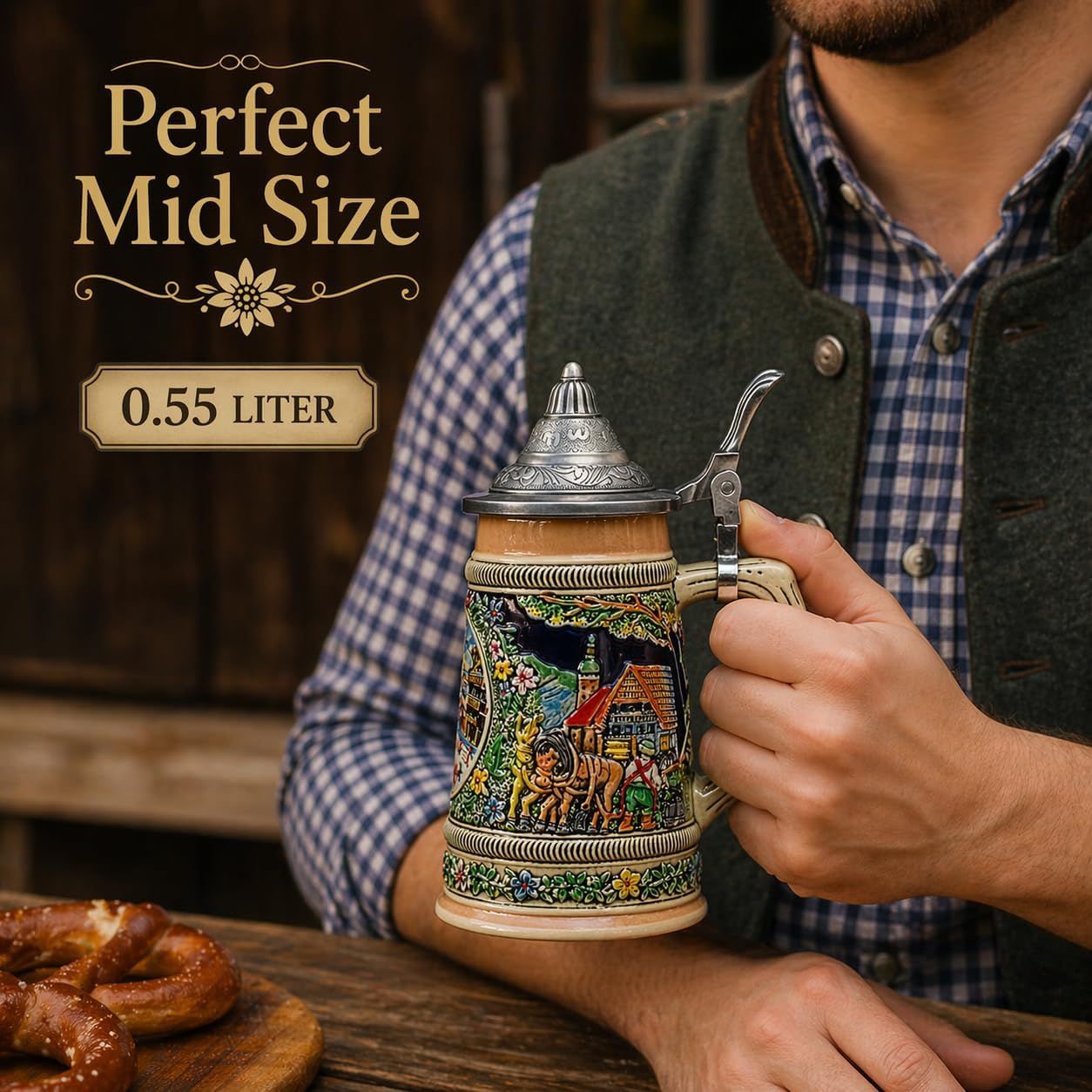
What is the difference between 0.55L, 0.6L, and 1.0L steins for gifting vs. actual drinking? For gifting and display, the 1.0L format reads as more impressive and visually traditional. For actual regular drinking, 0.5L–0.6L is significantly more practical — lighter when full, easier to handle, and better-suited to standard serving quantities. The 0.55L is effectively a half-liter with a slight overrun; the 0.6L is a European standard that splits the difference. If the recipient will drink from it daily, go 0.5L–0.6L. If it’s primarily decorative or occasional, 1.0L has more shelf presence.
Can a decorative collectible stein be used for real beer, or just for display? Most ceramic and stoneware steins labeled as collectibles can be used for drinking if the glaze is food-safe and the lid meets food-safe standards — check both. Purely decorative steins sometimes use non-food-safe paints or metallic finishes on interior surfaces; these should not be used for drinking. When product listings specify “dishwasher-safe” or “food-safe glaze,” that’s a reliable signal that functional use is intended. When listings are silent on interior finish, confirm before use.
Why do some pewter lids corrode and others don’t? Corrosion in pewter lids is typically the result of low-quality alloy composition — older or cheaper pewter formulations with higher lead or bismuth content, or thin plating over a base metal that isn’t pewter at all. Exposure to acidic liquids (beer is mildly acidic) and dishwasher cycles accelerates corrosion in substandard alloys. High-quality modern pewter is highly corrosion-resistant under normal use. The HomeWetBar corrosion reports are consistent with a lid sourced at a cost point that prioritized the personalization budget over lid material quality — a pattern to watch for across the personalized/engraved stein category.
The Decision Rule
If you’re building an annual gifting habit around seasonal steins — one per year, occasion-tied, accumulating into a shelf series — the entry tier works for Oktoberfest and novelty occasions, but wash any new piece before use and manage expectations on lid ergonomics at 1.0L. For a recipient who will actually drink from the stein regularly, size down to 0.5L–0.6L and confirm food-safe lid specs before committing. For the buyer who has been through a few entry-tier pieces and wants something that feels materially authentic, stoneware is the honest next step. And at the personalized tier: buy for the engraving, not the lid — and set expectations accordingly.